
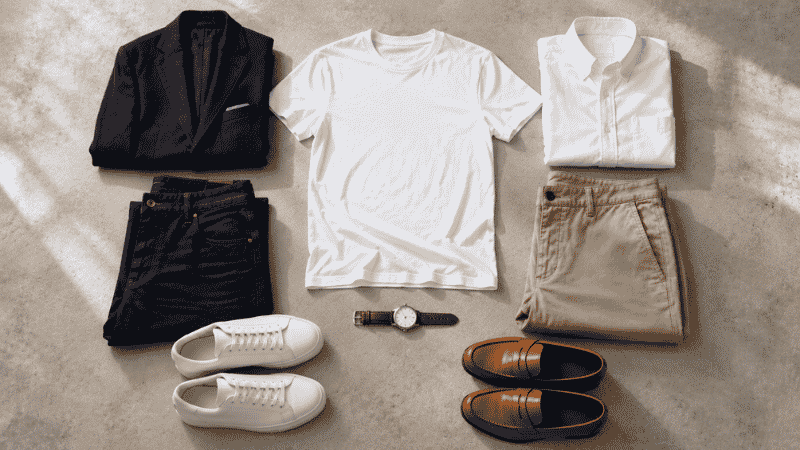
At some point, most men reach the same moment. You’re getting ready for something that matters—a job interview, a first date, a work event—and you realize that nothing in your closet feels right. Not wrong exactly. Just… not right. Uninspiring. Like clothes that happened to you rather than clothes you chose.
Maybe you’ve been wearing the same rotation for years. Maybe you gained or lost weight and the wardrobe never caught up. Maybe you never really thought about it until now, and now you’re standing in front of an open closet at 7am with somewhere to be in forty minutes.
Here’s the honest truth: most men don’t dress badly because they have bad taste. They dress badly because they don’t have a system. They shop randomly, buy things that seem fine individually, and end up with a closet full of clothes that don’t work together.
This guide gives you the system. Not 22 rules. Not a list of 50 must-have pieces. Three principles that cover 90% of what actually makes men look better—and a clear starting point so you know exactly what to do first.
Key Takeaways
- Fit is responsible for roughly 90% of style mistakes—clothes that don’t fit correctly undermine everything else
- A neutral color foundation (navy, white, grey, khaki) means any combination you pull from your closet will work together
- You need far fewer clothes than you think—12–15 core pieces cover most situations most men face
- The order matters: fix fit first, build basics second, add personality third
- Research from the Journal of Experimental Psychology confirms that clothing significantly influences both self-perception and how others evaluate competence and confidence
Why Most Men’s Style Advice Doesn’t Work
Open any men’s style guide and you’ll find a list. Twenty tips. Fifteen rules. Forty must-have items. The problem with lists is they give you information without priority. Knowing that “accessories matter” and “fit is important” and “invest in quality shoes” simultaneously doesn’t tell you what to do on Saturday when you’re at the mall with two hours and $200.
The men who dress well consistently aren’t following a long list of rules. They’ve internalized a short set of principles that operate as a filter for every purchase and every outfit decision. Something fits or it doesn’t. A color works with what they own or it doesn’t. They reach for the same reliable combinations on autopilot and look consistently put-together without thinking hard about it.
That’s the goal. Not fashion expertise. Autopilot.
The Three Levers That Change Everything
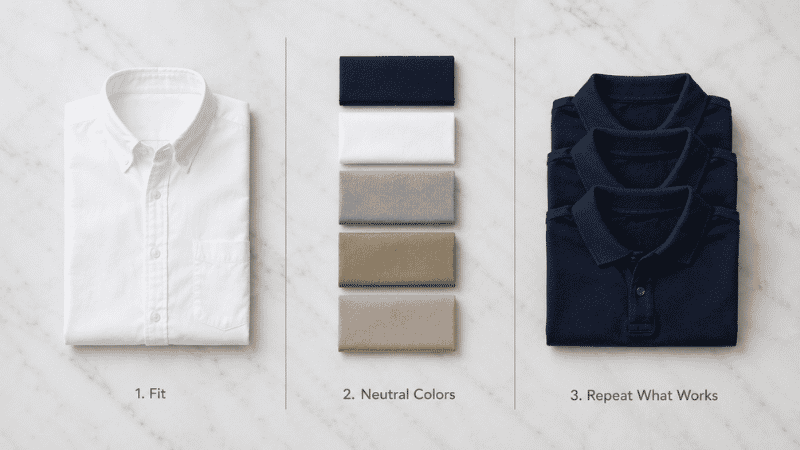
Lever 1: Fit
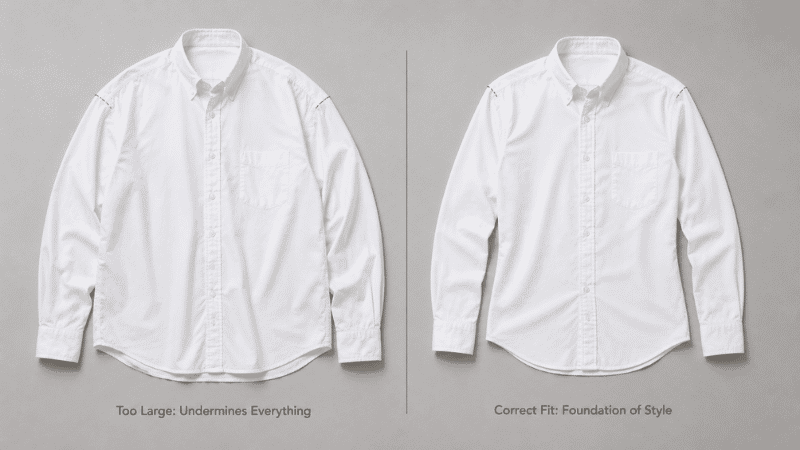
This is not just the most important thing. It’s the only thing that matters until you get it right.
Research consistently shows that clothing fit influences perceived competence, trustworthiness, and overall impression more than any other style variable. A well-fitting $40 shirt looks better than a poorly fitting $200 one. Always. Without exception.
The specific rules of fit for each garment type matter, but the underlying principle is simple: your clothes should follow the lines of your body without clinging to them. Fabric that pools, sags, or stretches is telling you something is wrong.
For shirts and jackets: The shoulder seam sits exactly at the edge of your shoulder bone. The chest skims without pulling. Sleeves end at mid-bicep (t-shirts) or at the base of the thumb (dress shirts and jackets).
For trousers and jeans: Sits at the natural waist. Enough room through the seat to sit and move without pulling. Hem touches the top of the shoe with minimal stacking.
Most men have at least some pieces in their current wardrobe that are the wrong size. Not dramatically wrong—just slightly too large in the shoulders, slightly too long in the leg. These small errors compound. A shirt that’s technically wearable but slightly too big through the chest and shoulders makes the whole outfit look like it belongs to someone else.
The cheapest style upgrade available to most men: take two or three pieces to a tailor. Hemming trousers costs $15–20. Taking in a shirt at the sides costs $20–30. These alterations turn clothes that are fine into clothes that look like they were made for you.
Lever 2: Neutral Colors
The second lever is color—specifically, building your foundation in neutral colors before adding anything else.
Neutral colors are the ones that pair with each other automatically: navy, white, off-white, grey, khaki, tan, and black. The reason they work together is that they don’t compete. When you put a navy shirt with khaki trousers and white sneakers, there’s no color conflict to manage. Your eye reads the outfit as cohesive without any deliberate effort.
This matters more than most men realize. The reason some wardrobes feel like they “don’t go together” isn’t usually that the individual pieces are wrong—it’s that they were bought without thinking about how they’d interact. A red-and-black patterned shirt, olive trousers, and dark grey sneakers can all be technically fine pieces and still look like a mess together.
The practical rule: Build your entire wardrobe foundation in neutrals. Every purchase should be something you can wear with at least three other things you already own. Once the foundation is solid—which takes maybe 10–15 pieces—you can add one or two items with more color or personality. A burgundy crewneck over navy chinos with white sneakers looks intentional because the neutrals underneath give the color somewhere to land.
One note on black: it’s a neutral, but use it sparingly in casual contexts. Navy and charcoal grey are more versatile at the casual end of the spectrum because they pair more naturally with warm-toned pieces like khaki and tan.
Lever 3: Repeat What Works
The third lever is psychological, and it’s the one most style guides completely ignore.
Once you find an outfit combination that works—that makes you feel good, that gets a compliment, that you feel genuinely confident wearing—wear it again. And again. And again.
Most men treat their wardrobe like a puzzle they need to solve differently every morning. They experiment constantly, have some wins and some losses, and never build the systematic confidence that comes from knowing certain combinations always work.
The men who dress well reliably don’t have endless creativity. They have a small number of reliable outfit formulas that they return to repeatedly. A navy blazer over a white tee with dark jeans. Khaki chinos with an Oxford shirt and loafers. A grey crewneck with chinos and white sneakers. These aren’t boring—they’re efficient. They free up cognitive space for things that actually matter.
When you find something that works: note it. Wear it regularly. Build around it.
How to Dress Better: The Starting Point
If you’re starting from scratch or rebuilding, don’t try to fix everything at once. This is where most men lose momentum—they get overwhelmed by the scope of the project and either buy too much without a plan or do nothing.
Follow this sequence instead.
Step 1: Audit What You Have
Before buying anything, spend thirty minutes going through what you currently own. Try things on. Set aside anything that doesn’t fit correctly. Create a small pile of pieces you actually reach for regularly—these are your real starting point.
Most men discover they wear about 20% of their wardrobe on 80% of their days. The 20% you reach for naturally is telling you what your actual style preferences are, which is more useful information than any style guide.
Step 2: Fix Fit Before Adding Anything New
Take the pieces that are close to fitting—good fabric, right color, wrong size—to a tailor. Get the shoulders right, the trousers hemmed, the shirt taken in if needed. This step often transforms pieces you barely wear into things you reach for consistently.
Only after this step do you identify what’s genuinely missing.
Step 3: Fill Gaps With Basics, Not Statements
The gaps you’ll typically find: a pair of well-fitting dark jeans, a white or light blue Oxford shirt, chinos in khaki or navy, clean leather shoes or white leather sneakers. These are the pieces that form the connective tissue of a wardrobe—they make everything else work together.
Resist the urge to fill gaps with statement pieces, “interesting” items, or anything that only works with one specific combination. Every new purchase should solve a real gap in the system, not add complexity to it.
Step 4: Build Outfit Formulas
Once you have the basics in place, build 4–5 outfit formulas that you can assemble without thinking. Write them down if it helps.
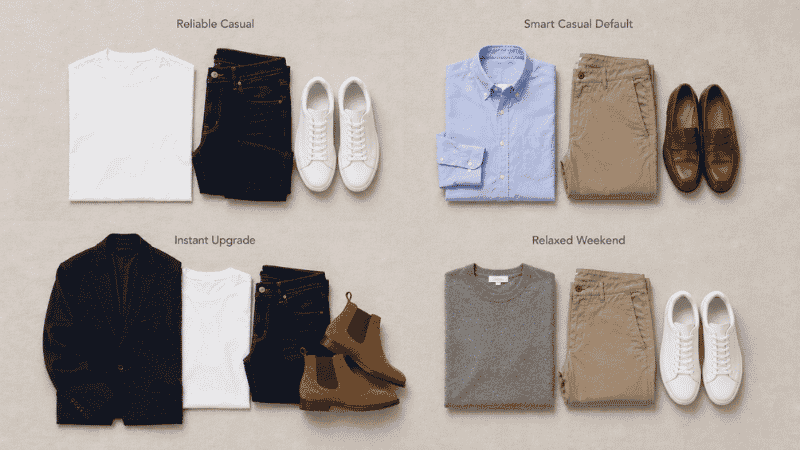
Here are four to start with—each one works across a wide range of everyday situations:
The Reliable Casual: White or grey t-shirt + dark slim-straight jeans + white leather sneakers. This works for 80% of casual situations.
The Smart Casual Default: OCBD shirt (tucked or loosely tucked) + khaki chinos + leather loafers or chelsea boots. Works for most office environments and smart casual social situations.
The Instant Upgrade: Navy unstructured blazer + white tee or OCBD + dark jeans + leather shoes or clean sneakers. Use this when you need to look more intentional in under sixty seconds.
The Relaxed Weekend: Grey crewneck sweater + chinos + white sneakers. Low-effort, consistently clean-looking.
These four formulas handle most situations most men face in an average week.
The Most Common Style Mistakes Men Make
Understanding what goes wrong helps you avoid it. These are the four mistakes that appear most consistently.
Buying for the outfit you want to have, not the life you actually live. A beautifully tailored suit hanging in a closet because you never have occasion to wear it is a common example. Buy for your actual week, not your aspirational week.
Shopping without a plan. Walking into a store without knowing what gap you’re filling leads to buying things that look good on the hanger but don’t connect to anything you own. The three-item rule helps here: before any purchase, identify at least three things in your current wardrobe it pairs with. If you can’t name three, leave it.
Ignoring shoes. Shoes communicate more about how much thought you’ve put into your appearance than almost any other item. Scuffed trainers under a smart outfit create friction that undermines the whole look. One good pair of leather shoes and one pair of clean leather sneakers—both well-maintained—handles most situations.
Trying to make big changes all at once. A sudden complete wardrobe overhaul usually leads to a lot of money spent on things that don’t cohere. Gradual improvement—one better piece replacing one worse one at a time—produces a wardrobe that actually works.
What to Wear: Situation-by-Situation
Daily commute / office (business casual): Oxford shirt or polo + chinos + leather shoes or chelsea boots. Blazer if the environment is more formal.
Casual weekend: Well-fitting t-shirt + dark jeans + clean sneakers. Simple, but execution matters.
Smart casual event (dinner, drinks, date): Navy blazer + white tee or OCBD + dark jeans + leather shoes. Instant upgrade.
Warmer weather: Linen shirt (short or long sleeve) + chino shorts + leather sandals or loafers. Fabric choice becomes the primary styling decision in summer.
Formal occasion: If you own a navy or charcoal suit that fits, wear it. If you don’t, a well-fitted blazer with dress trousers and a white dress shirt handles most semi-formal situations.
Building From Here: The Full Modvello System
This guide covers the principles. Each piece of the system is covered in depth in the articles below—click through to the one that’s most relevant to where you are right now.
Start with the foundation:
- Capsule Wardrobe for Men: 10 Basics That Cover Every Situation — the 10 pieces that make everything else work
- Men’s Wardrobe Essentials: What to Buy, What to Skip, and Where to Start — buying priority order and budget guidance
Dress for specific situations:
- Business Casual Dress Code for Men: What It Actually Means — industry-by-industry breakdown
- What to Wear in Summer: The Men’s Guide to Looking Good When It’s Hot — fabric-first summer guide
Style specific pieces:
- How to Wear Chinos: Men’s Outfit Ideas From Office to Weekend — 7 complete chino outfit formulas
- White T-Shirt Outfits for Men: 5 Ways to Wear the Most Useful Item You Own — the most underrated wardrobe piece
Buy the right things:
- The Best Chinos for Men in 2026: Honest Picks at Every Budget — tested recommendations at every price point
FAQ
How do I start dressing better as a man? Start with fit, not new purchases. Go through what you own, set aside anything that doesn’t fit correctly, and take the pieces worth keeping to a tailor. Once fit is sorted, identify what’s genuinely missing—usually a pair of well-fitting dark jeans, a reliable Oxford shirt, and clean footwear. Build those basics before adding anything with more personality.
What are the most important style rules for men? Three: fit first (clothes that don’t fit correctly undermine everything else), neutral color foundation (navy, white, grey, khaki pair together automatically), and repeat what works (find 4–5 outfit formulas that are reliable and return to them consistently). Everything else is secondary.
How can a man look stylish without spending a lot of money? Tailoring is the highest-return investment in men’s style. Getting trousers hemmed and shirts taken in at the sides costs $15–40 per piece and transforms the fit of clothes you already own. Beyond that, Uniqlo and Amazon Essentials consistently offer quality basics at accessible prices. Focus on fit and neutral colors over brand names.
What colors should men wear? Build the foundation in neutrals: navy, white, grey, khaki, and tan. These colors pair with each other automatically, which means you can combine any top and bottom from this palette without thinking. Once the foundation is established, add one or two pieces in a deeper accent color—burgundy, olive, or forest green all work well with neutral foundations.
How many clothes does a man actually need? Research suggests most people regularly wear about 20% of what they own. A functional wardrobe covers most situations with 12–15 core pieces: 2–3 t-shirts, 1–2 shirts, 1 sweater, 1 blazer, 2 pairs of trousers, 1–2 pairs of jeans, 2 pairs of shoes, a watch, and a belt. More than this is fine, but quantity doesn’t improve the system—quality and cohesion do.
References
- Adam, H., & Galinsky, A. D. (2012). “Enclothed Cognition.” Journal of Experimental Psychology: General, 141(4), 997–1006 — research on how clothing influences psychological processes and performance
- Howlett, N., et al. (2015). “The influence of clothing on first impressions.” Journal of Fashion Marketing and Management — research on how fit and formality influence perceived competence and trustworthiness
- MaleFashionAdvice Substack, “A Step-by-Step Guide to Starting to Dress Well for the Risk-Averse Neophyte” — community-sourced beginner guidance
- MaleFashionAdvice Substack, “How the Basic Wardrobe Has Changed: A 2023 Supplement” — updated guidance on fit and silhouette
Last updated: June 2026 | Written by Daniel Ross