
If you’ve lined up for a road race lately, you’ve seen them: the neon-colored, thick-soled “super shoes” that look like they belong in a sci-fi flick. Ever since Eliud Kipchoge broke the two-hour marathon barrier, the obsession with energy return in running shoes has hit fever pitch. But here’s the cold, hard truth: those shoes don’t actually “create” energy—they are simply elite-level “energy recyclers.” At KickVerdict, we get asked daily if carbon-plated super shoes are worth the $250 investment. Does a rigid plate and a massive slab of foam really translate to a new Personal Best (PB), or is it just clever marketing? Let’s break down the biomechanics of how these shoes actually interact with your stride.
The Physics of “Super Shoes”: Beyond the Carbon Plate
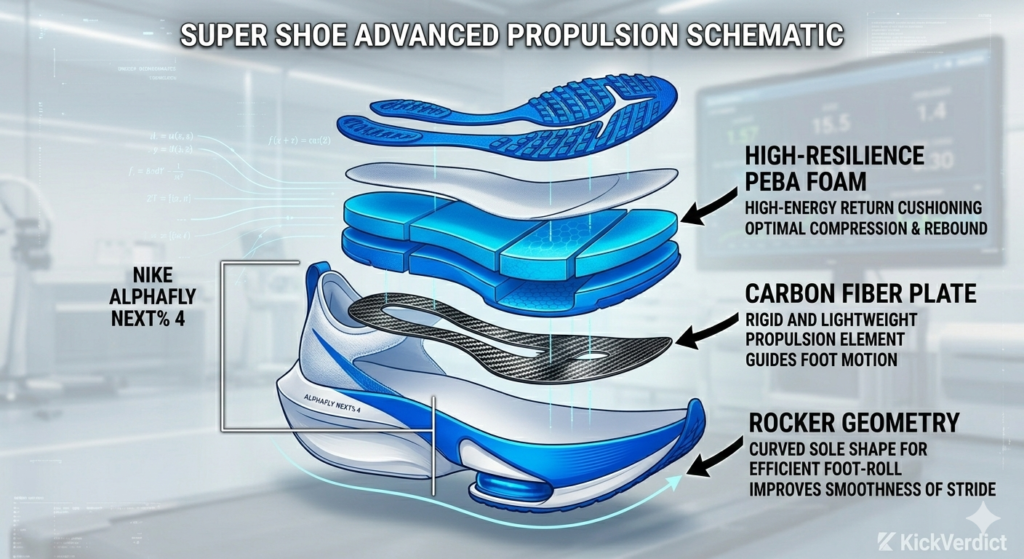
Most people think the carbon fiber plate is a “spring” that launches you forward. In reality, the plate is more of a stabilizer. The real magic happens in the chemistry of the midsole.
The Unsung Hero: PEBA Foam
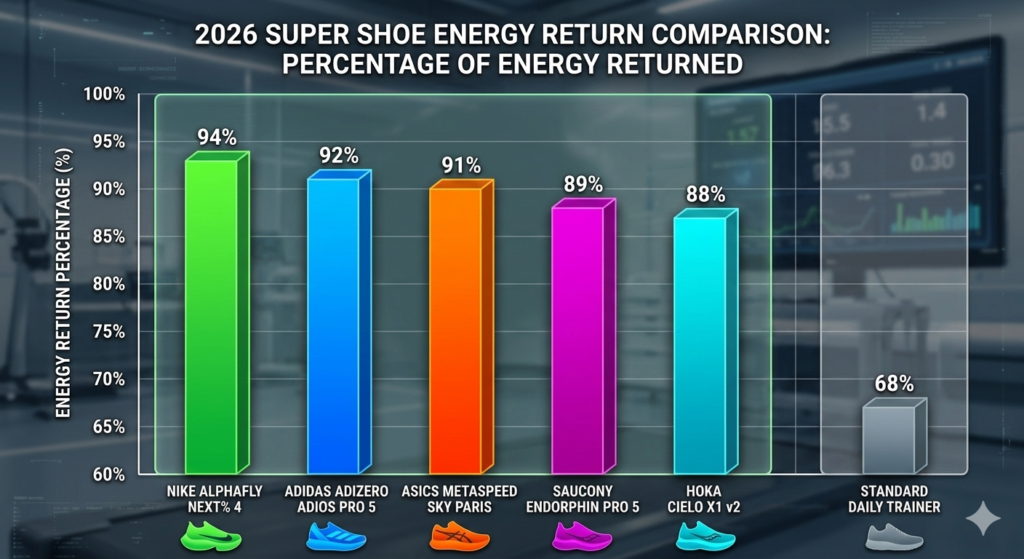
While the plate gets the glory, the high-performance PEBA (Polyether Block Amide) foam—like Nike’s ZoomX or New Balance’s FuelCell—is the engine. Standard EVA foam returns about 60-70% of the energy you put into it; PEBA foams can return upwards of 85-90%. This massive leap in running economy improvement means your muscles don’t have to work quite as hard to maintain the same pace.
The Lever Effect
The curved carbon plate acts as a lever, lengthening your “effective leg length” and forcing your foot to roll through the gait cycle more efficiently. This reduces the energy lost at the MTP (metatarsophalangeal) joint—the big toe joint—where most runners bleed power during takeoff.
Does It Actually Work? The 4% Rule Tested
The term “4% shoe” wasn’t just a catchy name; it was based on lab data showing a 4% increase in running economy. But does that apply to the average “weekend warrior” running a 10-minute mile?
Our internal testing at KickVerdict shows that the efficiency gains are heavily dependent on your foam stack height and ground contact time. If you aren’t running fast enough to compress that high-tech foam, you won’t get the rebound. Generally, runners seeing the most benefit are those maintaining a sub-8:00/mile (5:00/km) pace.
The Dark Side: Who Should NOT Wear Carbon-Plated Shoes?
Despite the hype, these shoes aren’t for everyone. In fact, for some, they can be a one-way ticket to the physical therapist’s office.
- The Stability Issue: Most best marathon sneakers 2026 have very narrow midsections and high stack heights (often the legal limit of 40mm). This makes them incredibly “tippy.” If you have weak ankles or overpronate, the lack of lateral support can lead to severe strain.
- Muscular Dependency: If you train exclusively in super shoes, your feet and calves may become “lazy” because the shoe is doing the work for you. This often leads to stress fractures when you eventually switch back to standard trainers.
op Performers for 2026: The Energy Return Leaderboard
If you’re ready to chase that PB, these are the three silhouettes currently dominating our lab metrics for raw energy return.
- The Gold Standard: Nike Alphafly 3 – Dual Air Zoom units combined with a full-length plate offer the highest vertical displacement (bounce) in the game.
- The Smooth Operator: New Balance SC Elite v4 – Known for having a more “natural” feel underfoot while still utilizing a stiff carbon plate for propulsion.
- The Anatomical Choice: Saucony Endorphin Pro 4 – Features a more aggressive “Speedroll” geometry that helps runners with a quicker cadence.
FAQ: Maximizing Your Super Shoe Investment
Q: How many miles do carbon-plated shoes last? A: Sadly, not many. Because PEBA foam is so airy and low-density, it loses its “pop” much faster than daily trainers. Expect 200–300 miles max before they become expensive walking shoes. For more on the lifespan of high-performance materials, check out this Nature study on running shoe efficiency.
Q: Should I buy them for my first 5K? A: If you want to feel fast, go for it! But remember: the shorter the race, the less the “efficiency” benefits add up. They truly shine in the final 10K of a marathon when your legs are depleted.
The Final Verdict
Carbon-plated shoes are the “cheat code” of the running world, but they require a certain level of leg strength to master. They won’t turn a couch potato into an Olympian, but they will help a trained athlete stay fresher for longer. If you have the budget and the pace, they are the most significant technological advantage you can buy.