
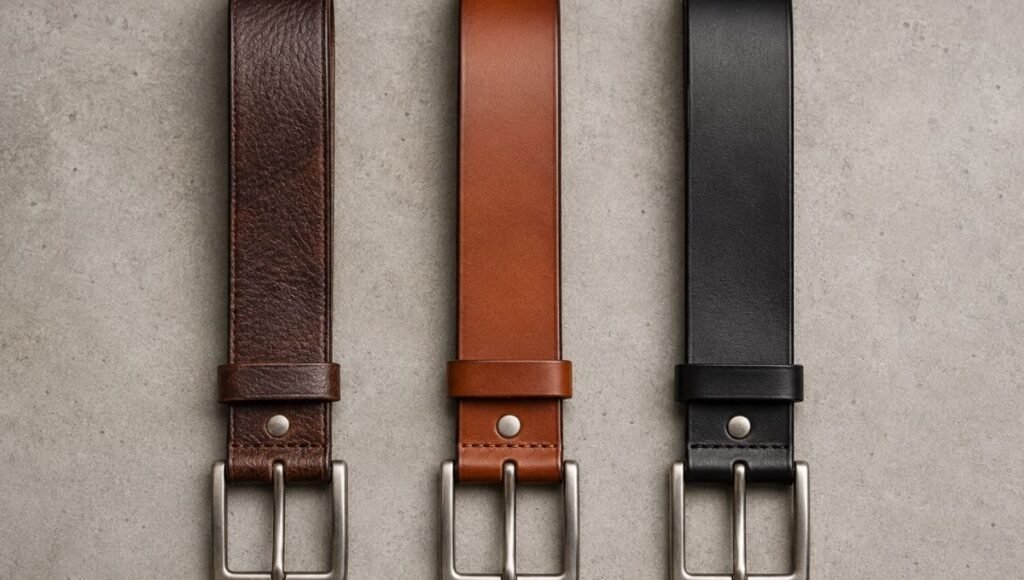
You’ve bought a leather belt that cracked along the edges after eighteen months. Or one that started peeling at the fold point within a year. Or one that looked sharp in the store and faded into a dull, lifeless strip of brown within a season.
All of these belts had one thing in common: they were labeled “genuine leather.”
Here’s what most men don’t know when they’re standing in a store looking at belts: “genuine leather” is not a quality claim. It’s one of the lowest grades of leather on the market — a category that includes scraps and off-cuts bonded together and finished to look like real leather. It’s legally accurate, which is why it appears on the label. It’s also why the belt you bought for $40 looked cheap after a year while your grandfather’s belt, which cost equivalent money in 1975, is still intact.
This guide explains the leather grade system that the industry doesn’t make obvious, then gives you specific belt recommendations at three price tiers — so the next belt you buy actually lasts.
Key Takeaways
- “Genuine leather” is a low-grade leather label, not a quality endorsement — it typically lasts 2-4 years before significant degradation
- Full grain leather is the highest quality — it develops a patina over time and can last 10-20 years with basic care
- Belt width matters as much as leather quality: 1.25–1.5 inches for dress use, 1.5 inches for casual, 1.5–1.75 inches for jeans
- The buckle attachment method (stitched vs. glued) significantly affects longevity — stitched buckles outlast glued ones
- A quality leather belt matched to shoe color reads as intentional; a mismatched or worn belt undermines any outfit above it
The Leather Grade System Most Men Have Never Heard Of
Before the recommendations, the framework that changes how you shop for belts forever.
Leather is graded by where it comes from on the hide and how much processing it undergoes. Four grades matter for belts:
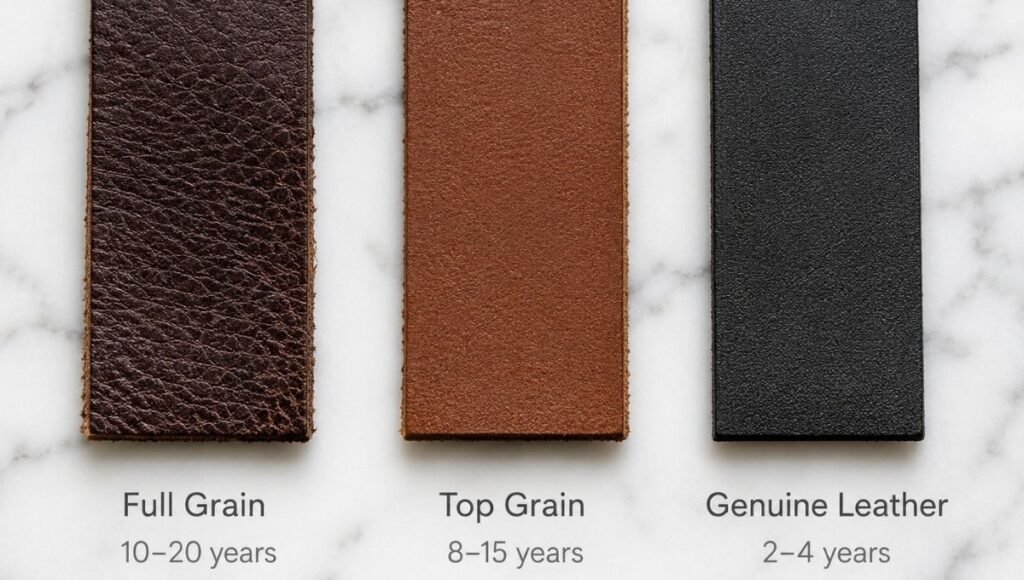
Full Grain Leather The outermost layer of the hide, with the natural grain surface intact. Nothing is sanded or buffed away. Full grain is the densest, strongest part of the hide — it resists moisture, develops a rich patina with age, and becomes more supple (not less) over years of wear. A full grain leather belt that is well cared for can last 10 to 20 years or more. It’s the highest quality leather available.
Visual cue: slight natural variations in grain pattern — not perfectly uniform, because it hasn’t been processed to uniformity.
Top Grain Leather The second-highest grade. The top surface is sanded or buffed to remove imperfections, then finished to create a uniform appearance. More consistent looking than full grain but less durable — the sanding removes some of the hide’s natural strength. Top grain belts typically last 8-15 years. Still a solid choice for the price.
Genuine Leather Despite the name, this is one of the lower grades. It’s made from the inner layers of the hide — the parts left after full and top grain are removed — often bonded together and given a surface finish. It looks like leather and initially feels like leather. It doesn’t age like leather. Genuine leather belts typically last 2-4 years before cracking, peeling, or splitting at stress points. Most belts in the $20-40 price range are genuine leather.
Bonded Leather The lowest grade — leather scraps and fibers bonded with polyurethane. Often used in very inexpensive belts. The surface layer peels away relatively quickly under regular use. Avoid for any belt you plan to wear regularly.
The practical implication: price alone doesn’t tell you what grade you’re buying. Always look for “full grain” or “top grain” on the label or product description — not just “leather” or “genuine leather.”
What to Look for Beyond the Leather Grade
Width
Belt width should match the belt loops of what you’re wearing and the formality of the occasion.
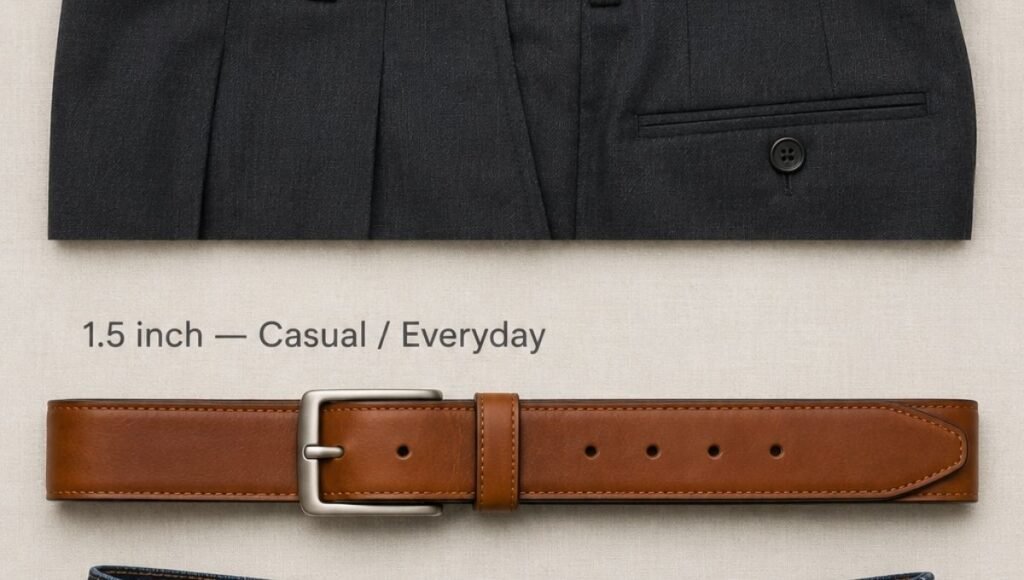
- 1.25 inches: Dress and formal contexts — suits, dress trousers. Narrow, clean, elegant.
- 1.5 inches: The most versatile width. Works for both chinos/smart casual and jeans.
- 1.5–1.75 inches: Casual and denim contexts. Wider reads as more relaxed.
A formal dress belt with jeans looks unbalanced — the narrow width looks lost in wider loops. A casual wide belt with a suit reads as an afterthought. Width is the easiest way to match your belt to the occasion.
Buckle Attachment
The buckle is where most belts fail first. Two attachment methods exist:
Stitched: The strap wraps around the buckle bar and is stitched back on itself. The stitching distributes the stress of daily buckling across the leather and thread. More durable. Found on quality belts.
Glued or Riveted (poorly): Cheaper construction. The glue degrades over time and the strap separates from the buckle — often within a year of daily wear.
Check this before buying: on a quality belt, you’ll see visible stitching at the buckle end. On a cheaper belt, the attachment point looks smooth and uniform because it’s glued.
Buckle Finish
Polished silver hardware reads as formal and pairs best with silver-toned accessories. Brushed nickel or gunmetal reads as modern and versatile. Brass reads as warm and casual. Match your buckle to your watch and other hardware when possible — it creates visual coherence that reads as attention to detail.
The Best Leather Belts for Men: By Budget
Under $40: Best Value
Amazon Essentials Men’s Leather Belt ~$20–25 | Genuine leather | Multiple widths and colors
At this price point, genuine leather is the norm rather than the exception — and Amazon Essentials delivers the category reasonably well. The construction is straightforward, the hardware is solid, and the belt functions correctly for casual and smart casual contexts. Expect 3-4 years of regular wear before showing significant degradation.
Best for: Men who need a functional belt at minimal cost, or who want a casual belt for rotating wardrobes.
The honest limitation: The leather is genuine grade — it won’t develop a patina and will begin to show wear at stress points within a few years. For a belt you’ll wear daily, the math on quality vs. longevity points toward the next tier up.
Timberland Men’s 35mm Leather Belt ~$30–35 | Top grain leather | Multiple colors
The Timberland belt sits at the top of the under-$40 tier and punches noticeably above it. The leather is top grain rather than genuine — a meaningful upgrade in durability and appearance over time. The hardware is solid and the stitching at the buckle attachment is visible and clean.
Best for: Men who want a casual belt that will last 5-8 years rather than 2-4. Good for jeans and chinos.
$40–$80: Best Overall Value
Trafalgar Men’s Leather Dress Belt ~$45–65 | Top grain leather | Multiple colors and widths
Trafalgar is consistently recommended in men’s style communities for dress belt quality at an accessible price. The 1.25-inch dress version pairs cleanly with suits and dress trousers. The leather is top grain with visible natural grain variations — it reads as quality. The buckle hardware is solid and the stitching at the attachment point is clean and reinforced.
The editorial view: If you need one dress belt that holds up through professional contexts for years, Trafalgar at this price point is the clearest recommendation in the category. It won’t age as dramatically as full grain leather, but it will maintain its appearance significantly longer than genuine leather alternatives.
Best for: Office environments, formal occasions, men who need a reliable dress belt without spending full-grain prices.
Fossil Men’s Leather Belt ~$35–55 | Top grain leather | Multiple styles
Fossil occupies useful middle ground — top grain leather at a price that’s accessible without compromising significantly on construction. The casual versions (1.5 inch) work well for jeans and chinos. The stitching is consistent and the hardware has a quality feel. Multiple finish options (silver, brass, gunmetal) make it easy to match existing accessories.
Best for: Smart casual and casual contexts. Men who rotate between a dress belt and a casual belt.
$80+: Best Quality
Orion Leather Belt (USA Made) ~$95–120 | Full grain leather | Multiple widths and finishes
Orion Leather is the belt that appears most frequently in r/BuyItForLife discussions — the specific context where people are explicitly trying to buy once rather than repeatedly. Made in the USA from full grain leather with visible natural grain and hand-finished edges, this is a belt designed to last for decades rather than years.
The full grain leather will develop a patina — darkening and becoming more supple with wear in a way that genuine and top grain leather don’t. After five years of daily wear, an Orion belt looks better than it did when new. That’s not a claim you can make about any belt in the lower tiers.
The honest note: At $95-120, this is a significant investment relative to the category. The cost-per-wear math justifies it for a belt you wear daily — a $100 belt worn 300 days per year for 15 years costs $0.02 per wear. The math inverts if you only wear a belt occasionally.
Best for: Men who want to buy once and be done with it. Daily belt wearers. Anyone who’s replaced cheap belts multiple times and is ready to stop.
The Frye Men’s Belt ~$80–100 | Full grain leather | Multiple styles
Frye’s leather goods have a long reputation for quality construction and aging well. The belt offerings use full grain leather with clean hardware and visible stitching construction. The brand’s heritage in leather goods gives it credibility that some newer brands lack — they’ve been making leather products since 1863 and the construction reflects that institutional knowledge.
Best for: Men who want full grain quality with a heritage brand backing it at a slightly lower price point than Orion.
How to Match Your Belt to Your Outfit
The two rules that cover most situations:
Match leather color to shoe color. Brown belt with brown shoes, black belt with black shoes. This is the fundamental rule — mismatched leather colors create visual disconnection that reads as unconsidered. Tan belt with mid-brown shoes is close enough; tan belt with black shoes is a clear mismatch.
Match width to context. Narrow (1.25 inch) for formal and dress contexts; medium (1.5 inch) for smart casual; wider (1.5-1.75 inch) for casual and denim. A dress belt in jeans looks undersize; a casual belt in a suit looks out of place.
How to Make Your Leather Belt Last Longer
Quality leather responds to care. Basic maintenance extends the life of any leather belt significantly.
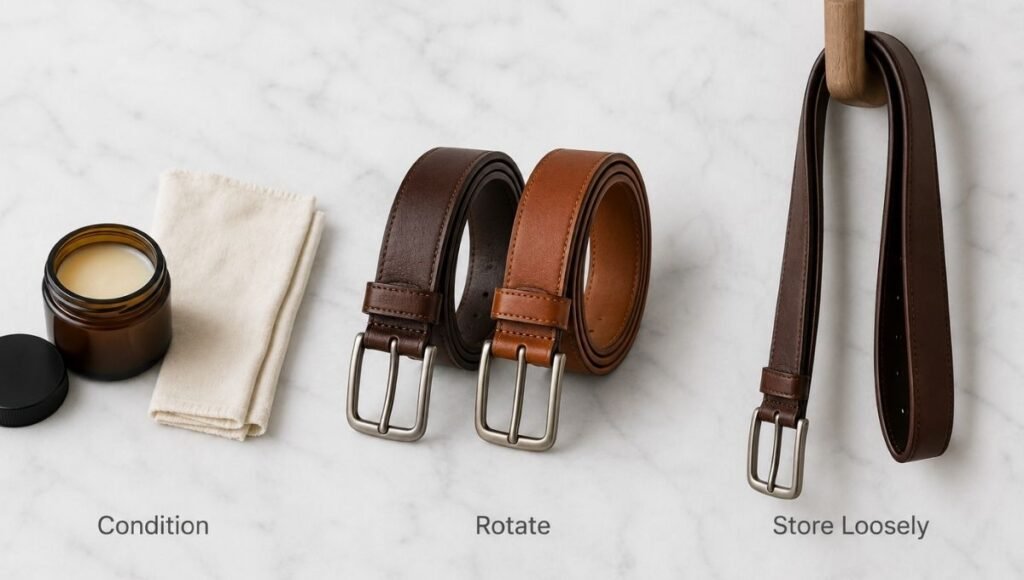
Condition every 3-6 months. Leather dries out with wear and loses suppleness. A leather conditioner (Leather Honey, Bick 4, or similar) applied every few months keeps the leather from cracking at flex points. Apply a small amount, work it in with a cloth, let it absorb overnight.
Rotate if you can. Daily wear on the same belt accelerates degradation. If you wear a belt every day, owning two and alternating between them doubles the lifespan of both.
Store loosely, not coiled tightly. Tight coiling creates crease lines that become cracks over time. Hang the belt on a hook or store it loosely rolled.
Clean before conditioning. Wipe the belt with a slightly damp cloth to remove surface dirt before applying conditioner. Applying conditioner over dirt traps it in the leather.
FAQ
What is the best leather belt for men? For daily wear and maximum longevity: Orion Leather (full grain, USA made) is the most consistently recommended option in quality-focused communities. For best value at a lower price: Timberland (top grain, ~$30) or Trafalgar for dress belts (~$50). The key is prioritizing full grain or top grain leather over “genuine leather” — the grade difference determines how long the belt actually lasts.
What is the difference between full grain and genuine leather belts? Full grain leather is the outermost hide layer with the natural grain intact — the strongest, most durable grade. It develops a patina over time and can last 10-20 years. Genuine leather is made from inner hide layers bonded together — despite the name, it’s one of the lower grades. Genuine leather belts typically last 2-4 years before cracking or peeling. The price difference between them is often less than $30, but the lifespan difference is 5-10 years.
What width belt should men wear? 1.25 inches for dress and formal contexts (suits, dress trousers). 1.5 inches for smart casual and most everyday wear — the most versatile width. 1.5-1.75 inches for casual and denim. The belt width should match the belt loops of what you’re wearing: dress trousers have narrow loops that look best with narrower belts; jeans have wider loops that accommodate wider belts.
Should men match belt to shoes? Yes — leather color should match. Brown belt with brown shoes, black belt with black shoes. Exact shade matching isn’t necessary (dark tan with medium brown works), but the broad color family should be consistent. Mismatched leather colors draw attention in a way that communicates lack of attention to detail. This is one of the easier and more impactful styling rules to follow consistently.
How long should a leather belt last? A full grain leather belt with basic care: 10-20 years. Top grain: 8-15 years. Genuine leather: 2-4 years. Bonded leather: 1-2 years. The grade of leather is the primary determinant of lifespan — not the brand or the price. A $35 belt in top grain leather will outlast a $50 belt in genuine leather by years.
References
- Myself Belts, “The Best Leather Belts: What Makes a Real Leather Belt Worth Buying” (May 2026) — leather grade hierarchy and lifespan data by grade
- KKICO, “Best Leather Belts for Men in 2026: Durable, Stylish & Worth Buying” (March 2026) — construction analysis and common buying mistakes
- Reddit r/BuyItForLife, “Recommendation for Men’s Leather Belt” — community-sourced brand recommendations with real-world longevity reporting
- The Modest Man, “Best Leather Belts for Men” (2026) — independent assessment of brands across price tiers
Explore More on Modvello
- Men’s Wardrobe Essentials: What to Buy, What to Skip, and Where to Start (Wardrobe Basics)
- The Best Chinos for Men: Honest Picks at Every Budget (Best Picks)
- The Best White T-Shirts for Men in 2026 (Best Picks)
- How to Dress Better: The Practical Men’s Style Guide (Wardrobe Basics)
- What to Wear With Grey Pants: The Men’s Complete Styling Guide (Outfit Ideas)
Last updated: June 2026 | Written by Daniel Ross