
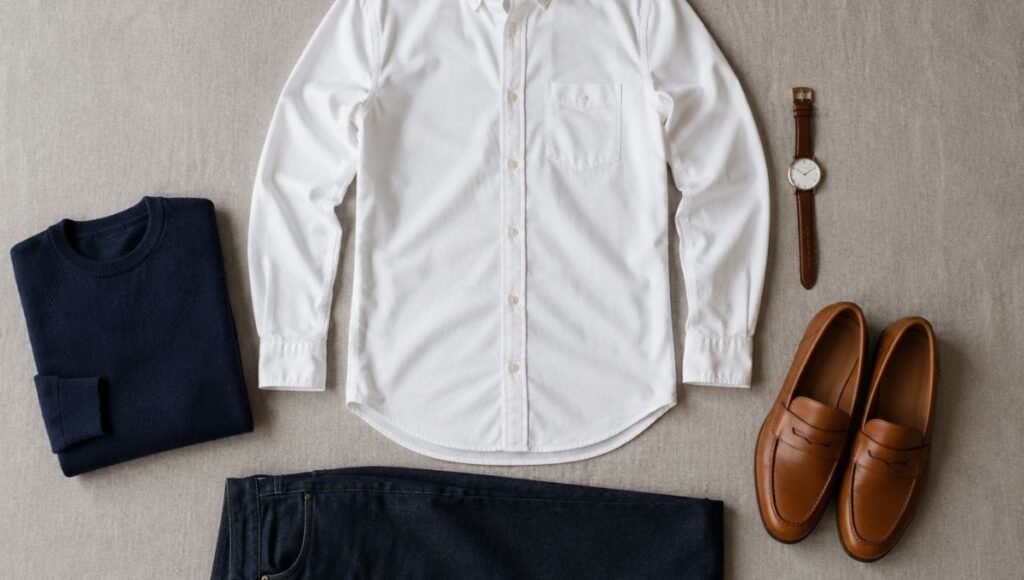
Here’s something most men who dress well won’t admit: they didn’t always. At some point, they were buying clothes that looked fine in the store and wrong in real life. Spending money on things that sat in the closet. Assuming their wardrobe problems were a budget issue when they were actually a system issue.
The men who consistently look put-together haven’t figured out something complicated. They’ve just learned a handful of things that most men never get told—not because the information is hard to find, but because most fashion content is aimed at people who already care about fashion. If you don’t, you’re mostly ignored.
This guide is for you. Not trend advice. Not capsule wardrobe theory. Ten specific, actionable fashion tips for men who want to look better without turning it into a hobby.
Key Takeaways
- Fit accounts for roughly 80% of how good an outfit looks — it matters more than brand, price, or style choices
- Neutral colors (navy, white, grey, khaki) combine automatically — they’re the foundation of any functional wardrobe
- Research on “enclothed cognition” (Northwestern University, 2012) confirms clothing directly influences self-perception and how others judge competence
- Most men over-buy and under-wear — the average person wears about 20% of their wardrobe 80% of the time
- Shoes are noticed before almost anything else — worn footwear undermines any outfit above it
The Three Things Most Men Are Getting Wrong
Before the tips, the honest diagnosis. These three mistakes account for the majority of wardrobe problems men have:
Buying for the ideal version of your life. The suit you bought for an occasion that never happened. The dressed-up shirt you thought you’d wear somewhere. Clothes you own in theory but never reach for in practice. The fix is buying for the week you actually live, not the one you imagine.
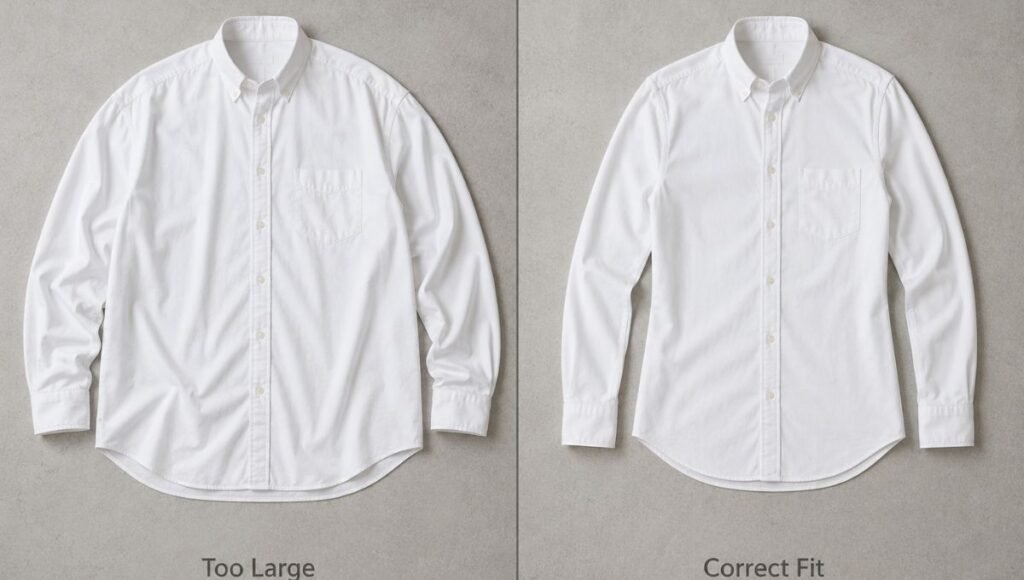
Treating size as fit. “I’m a medium” is not the same as “this medium fits me.” Sizing varies wildly between brands, and most men wear clothes that are too large across the shoulders and chest because it’s more comfortable when they try it on. It doesn’t look more comfortable from the outside.
Buying without a system. Individual pieces that look fine alone but don’t connect to anything else you own. A shirt that only works with one pair of trousers. Shoes that technically go with the outfit but require a mental effort to match. This is how closets fill up and mornings get harder.
Now the actual tips.
Tip 1: Fix Your Fit Before You Buy Anything New
This is the only fashion tip that matters as much as everything else combined.
A well-fitting $40 shirt looks better than a poorly fitting $200 one. Always. The reason: fit is what tells the eye that you made a considered choice. When clothes hang correctly — shoulder seam at the shoulder bone, chest skimming without pulling, trousers falling cleanly to the shoe — the outfit reads as intentional regardless of brand or price.
Most men can improve 60-70% of what they already own without spending a dollar. Find a tailor. Take in the shirts that bag at the waist. Hem the trousers that stack. Get the blazer’s shoulders assessed. Tailoring is the highest-return investment in men’s style — a $20-30 alteration transforms a piece that’s fine into one that looks made for you.
The one fit check worth doing right now: put on a shirt and look at the shoulder seams. They should sit exactly at the edge of your shoulder bone. If they hang over, the shirt is too large in a way that no alteration can fully fix.
Tip 2: Build on Neutral Colors First
The reason some wardrobes work and others don’t often comes down to one thing: whether the pieces combine automatically or require deliberate management.
Neutral colors — navy, white, grey, khaki, and tan — combine automatically. Any neutral top with any neutral bottom works without thinking. That’s not a simplification; it’s the design principle behind every functional wardrobe. When everything lives in the neutral zone, getting dressed stops being a daily puzzle.
The practical application: if you’re building from scratch, buy only neutral pieces until the foundation is solid. Every top should work with every bottom you own. Every shoe should work with every trouser. Once that system is in place, adding one accent piece — a burgundy sweater, an olive jacket — reads as personality rather than complexity.
The common mistake: buying statement pieces before the foundation exists. Statement pieces need neutral basics to land correctly. Without them, they look isolated rather than intentional.
Tip 3: Own Two Pairs of Good Shoes and Maintain Them
Research on first impressions consistently shows that shoes are among the first things noticed when meeting someone new. This isn’t surprising when you consider that most of the body presents a relatively similar range of clothing options — shoes are where individual choice is most visible.
The good news: you don’t need many pairs. Two covers most situations.
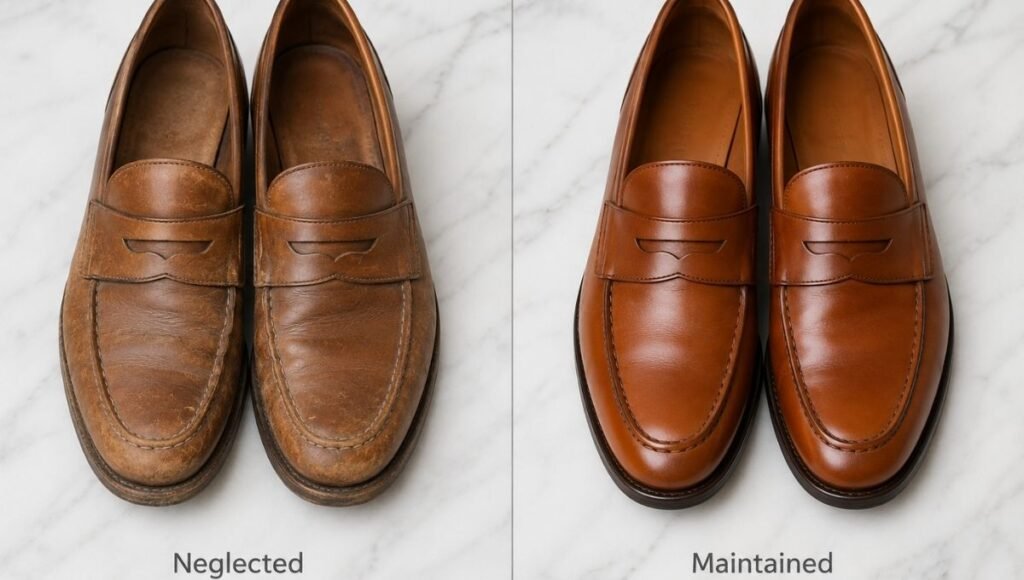
Clean white leather sneakers: Handles casual through smart casual. Works with jeans, chinos, and even some semi-formal combinations in modern environments. Keep them clean — pristine white sneakers read as intentional; scuffed ones read as neglect.
Leather loafers or chelsea boots in brown or tan: Covers smart casual through business casual. Pairs with chinos, dark jeans, and dress trousers. The brown or tan tone is more versatile than black in most non-formal contexts.
The maintenance part is non-negotiable. Worn-down heels, scuffed toes, or dirty soles undermine any combination above them. A simple shoe care routine — monthly conditioning, regular cleaning — extends the life of any leather shoe significantly and keeps them reading as cared-for rather than abandoned.
Tip 4: Wear Less, More Often
The average person wears about 20% of their wardrobe 80% of the time. Most men have more clothes than they need and fewer reliable outfits than they’d like.
The shift: stop thinking about individual pieces and start thinking about outfit combinations. When you find a combination that works — that gets a comment, that makes you feel like you’ve got it right — wear it again. And again. Men who dress well reliably do so through repetition, not endless variety.
This is also a buying filter. Before purchasing anything new, ask whether it can be paired with at least three things you already own. If not, it’s an orphan piece — it will look fine alone and create nothing as part of a system. Leave it.
Tip 5: Understand That Wrinkles Read as Carelessness
A 2024 survey by Zoosk of over 6,600 people found that 66% considered wrinkled clothing a significant negative impression signal. The item doesn’t need to be expensive or impressive — it just needs to not be wrinkled.
This is one of the cheapest style improvements available. A handheld steamer costs $25-40 and takes three minutes to use. A travel iron handles dress shirts in about five minutes. Neither requires skill.
The items that need the most attention: dress shirts, Oxford shirts worn as casual shirts, and linen anything. Dark t-shirts and knitwear tend to handle themselves. Denim rarely needs intervention.
The practical habit: before reaching for a shirt, do a ten-second visual check. If it’s visibly wrinkled, either steam it, iron it, or choose something else. This single habit, practiced consistently, changes how you read to everyone you meet that day.
Tip 6: Match Your Formality Level to the Situation
One of the most common men’s style mistakes isn’t being underdressed or overdressed — it’s not understanding that the same clothes can read as either depending on context.
A pair of dark jeans and a tucked Oxford shirt reads as business casual in a modern office and as smart casual at a casual dinner. The garments are identical; the context determines the reading. Understanding this means you can dress for situations rather than guessing.
The simple formality scale to keep in mind:
- Casual: Tee or crewneck + jeans or chinos + sneakers
- Smart Casual: Oxford shirt (tucked or untucked) + chinos + loafers
- Business Casual: Blazer + shirt + chinos + leather shoes
- Business Formal: Full suit + dress shirt + tie + leather shoes
Most situations men face fall into the first three categories. Knowing which one you’re in — and having the pieces to cover each — is more useful than having a large wardrobe of random items.
Tip 7: Invest in Quality at the Pieces You Wear Most
Not every piece needs to be expensive. But the items you wear constantly — the shoes, the everyday trousers, the go-to jacket — benefit from higher quality in a way that rarely-worn items don’t.
The reason is cost-per-wear. A $200 pair of shoes worn 200 times costs $1 per wear. A $50 pair worn 20 times before they fall apart costs $2.50 per wear. The more frequently you wear something, the more quality matters economically.
The practical priority list for investment:
- Shoes first — they see the most stress and affect the most impressions
- Everyday trousers second — the item you’re judged by in professional settings
- A blazer third — the highest-leverage single upgrade piece in most wardrobes
Everything else — casual tees, basic knitwear, simple shirts — can be bought at lower price points without meaningful quality sacrifice.
Tip 8: The Three-Item Rule for Shopping
Stop buying individual pieces you like. Start buying pieces that connect.
Before any clothing purchase, the three-item rule: identify at least three things you already own that work with the new piece. If you can name three, it earns its place. If you can’t, it will become an orphan piece — something that sits in your closet looking fine alone but never quite finding its place in an actual outfit.
This rule immediately cuts impulse buying, reduces closet clutter, and builds a wardrobe where everything connects to everything else. It’s the single most useful shopping habit in men’s fashion.
Tip 9: Grooming Is Part of the Outfit
Clothing gets the attention, but grooming determines whether the clothing reads as intentional or incidental.
This isn’t about elaborate routines. The baseline is three things: hair that looks like you chose it (not necessarily styled, just not accidental), facial hair that’s clearly maintained (fully clean-shaven or clearly intentional beard, nothing in between), and clean nails.
Research on impression formation consistently shows that grooming signals effort and attention to detail in ways that extend beyond the clothes themselves. A well-dressed man with obviously neglected grooming reads as inconsistent; a simply dressed man who is well-groomed reads as someone who pays attention.
The minimum daily grooming investment: five minutes. That’s the ceiling for what’s required to move the needle.
Tip 10: Stop Buying for Aspirational Occasions
The single most common source of wardrobe waste: clothes bought for a version of your life that doesn’t exist yet.
The formal shirt you thought you’d wear to events you haven’t attended. The office trousers you bought when you worked in a more formal environment. The holiday clothes that don’t quite fit the holidays you actually take.
The fix: a brutally honest audit. Every six months, pull out anything you haven’t worn in the last year and ask whether there’s a realistic occasion in the next six months where you’ll wear it. If not, donate it. The closet space it frees is more useful than the piece itself.
Buying only for the life you’re currently living creates a wardrobe that’s in constant use, wears out at a rate that signals it’s actually being worn, and costs less money overall because you stop accumulating pieces that serve no real purpose.
When Ten Minutes Is All You Have
No time to implement anything comprehensive. Here’s the ten-minute version:
Check the fit of whatever you’re wearing. Shoulder seams, chest, trouser length. If something is significantly off, change it or accept that this outfit isn’t working as well as it could.
Check your shoes. Are they clean? Do they match the formality level of everything above them? A ten-second check and a quick wipe with a damp cloth handles most situations.
Check for wrinkles. Top to bottom. If a shirt is visibly wrinkled and you have ten minutes, steam it. If you don’t have ten minutes, change to something unwrinkled.
That’s it. Fit, shoes, wrinkles. Manage these three things and you’ve covered the majority of what actually moves the needle on appearance.
FAQ
What are the most important fashion tips for men? The single most impactful tip is fit — clothes that fit correctly look intentional regardless of brand or price. After fit: build your wardrobe in neutral colors so everything combines automatically, invest in two good pairs of shoes and maintain them, and stop buying pieces that don’t connect to at least three other things you already own. These four things cover the majority of what makes men look consistently well-dressed.
How can men look more stylish without spending much money? The highest-return investment is tailoring existing clothes. Getting trousers hemmed ($15-25) and shirts taken in at the sides ($20-30) transforms pieces that are fine into ones that fit correctly. After tailoring: stop buying things that don’t work with what you already own, learn to identify and avoid wrinkles, and maintain the shoes you have rather than buying new ones. Most men have enough clothes — they just need the existing ones to work together.
What colors should men wear to look good? Build the foundation in neutrals: navy, white, grey, khaki, and tan. These colors combine automatically — any top works with any bottom within this palette. Once that foundation is working, add one or two accent pieces in a deeper color (burgundy, olive, forest green) for variety. Avoid building a wardrobe in colors that require deliberate management to combine — the goal is a system that works without thought.
How do men develop a personal style? Personal style develops from repetition, not experimentation. Find five to seven outfit combinations that work reliably — that feel right, that get positive feedback, that you feel confident in — and wear them consistently. Over time, you’ll notice patterns in what works for you: certain colors, certain silhouettes, certain levels of formality. That pattern is your personal style. It emerges from wearing what works, not from deliberate construction.
What is the biggest men’s fashion mistake? Buying individual pieces instead of outfit systems. Most wardrobe problems — “I have nothing to wear,” the closet that’s full but feels empty — trace back to orphan pieces: items that look fine alone but don’t connect to anything else. The fix is applying the three-item rule before every purchase: if a new piece doesn’t pair with at least three things you already own, leave it.
References
- Adam, H., & Galinsky, A. D. (2012). “Enclothed Cognition.” Journal of Experimental Psychology: General, 141(4), 997–1006 — research on how clothing influences self-perception and professional competence
- Zoosk, 2024 First Impressions Survey (6,600+ participants) — clothing condition as a significant factor in initial attraction and professional perception
- MaleFashionAdvice Substack, “A Comprehensive Guide to Men’s Style” — community-sourced best practices for entry-level male fashion
- ThredUp, 2024 Resale Report — wardrobe utilization data (20% of clothes worn 80% of the time)
Explore More on Modvello
- How to Dress Better: The Practical Men’s Style Guide (Wardrobe Basics)
- Capsule Wardrobe for Men: 10 Basics That Cover Every Situation (Wardrobe Basics)
- Men’s Wardrobe Essentials: What to Buy, What to Skip, and Where to Start (Wardrobe Basics)
- Men’s Clothing Size Chart: How to Measure and Find Your Perfect Fit (Fit & Sizing)
- Men’s Outfit Ideas: 20 Simple Combinations From 7 Basic Pieces (Outfit Ideas)
Last updated: June 2026 | Written by Daniel Ross