
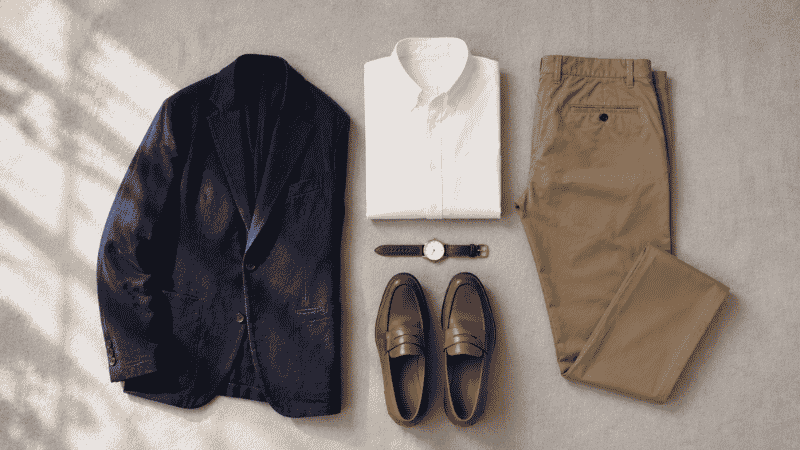
You get the calendar invite. New client meeting, Friday afternoon. Dress code: business casual.
You stand in front of your closet and feel absolutely nothing. Not because you don’t own clothes—you own plenty. It’s because “business casual” is one of those terms that sounds like it means something specific, but somehow leaves you more confused the more you think about it. Is a polo shirt okay? What about dark jeans? Can you wear sneakers or does that cross a line?
You end up either overdressing and feeling stiff all day, or underdressing and spending the meeting quietly wondering if everyone noticed.
Here’s the truth nobody tells you upfront: business casual doesn’t have one single definition. It shifts depending on your industry, your office culture, and sometimes even who’s walking through the door that day. But there is a logical framework behind it—and once you understand how it works, getting dressed for work becomes straightforward.
This guide breaks it down without the confusion.
Key Takeaways
- Business casual sits between a full suit and weekend clothes—polished, but not stiff
- The dress code means something different in a law firm vs. a tech startup vs. a creative agency
- Five core pieces handle 90% of business casual situations
- Fit is the single biggest factor—a well-fitting polo beats a baggy dress shirt every time
- When in genuine doubt, dress up slightly rather than down—it’s easier to remove a jacket than to wish you’d worn one
What Is Business Casual for Men, Actually?
The textbook definition goes something like this: business casual is a step below business formal (suits, ties, dress shoes) and a step above smart casual (clean jeans, casual shirts). It’s professional enough to be taken seriously in a meeting, relaxed enough that you’re not walking around in a full suit on a Thursday with no client in sight.
But that definition doesn’t help much when you’re standing in your bedroom at 7am.
A more useful way to think about it: business casual is any combination of clothes that makes you look intentional and put-together, without requiring a tie. The key word is intentional. A polo shirt can be business casual. An oxford shirt can be business casual. Even clean dark jeans can qualify in the right context. What they all have in common is that they look like you made a considered choice—not like you grabbed whatever was on the chair.
The opposite of business casual isn’t formal clothes. It’s clothes that look like you didn’t think about it.
Why Business Casual Means Different Things in Different Offices
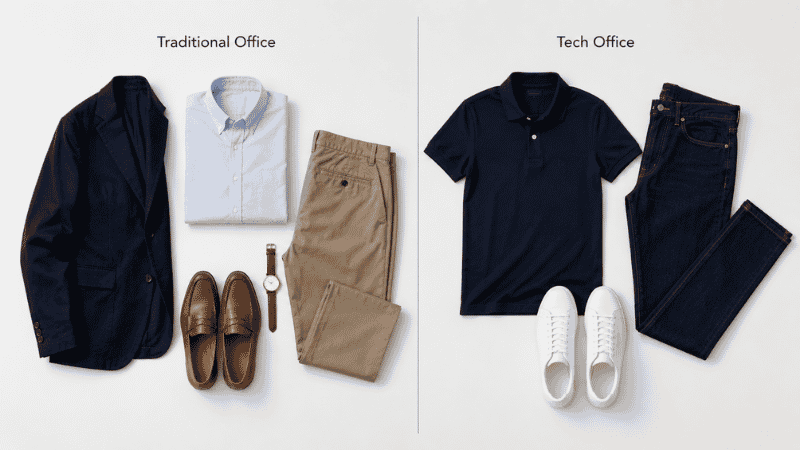
This is where most guides let you down. They give you a universal list—chinos, polo, blazer, loafers—as if every office in the world operates on the same dress code. They don’t.
A man working at a downtown law firm and a man working at a mid-size tech company might both have “business casual” written in their employee handbook. But what that looks like in practice is completely different.
Traditional industries (law, finance, consulting, corporate banking): Business casual here leans closer to business formal. Chinos over jeans. Oxford shirt over polo. A blazer is rarely wrong. Loafers or leather sneakers, not your everyday trainers. You can dress down from a suit here, but you can’t dress up from a t-shirt and call it done.
Mid-size companies and professional services: This is where the “classic” business casual advice lives—and it’s genuinely useful here. Chinos, a well-fitted shirt or polo, clean leather shoes or leather sneakers. A blazer when you have meetings, optional otherwise. This is the sweet spot most guides are writing for.
Tech companies and startups: Business casual here often means “slightly above jeans and a tee.” Dark wash jeans are typically fine. A clean polo or casual button-down covers you. No one is wearing a blazer unless there’s an investor meeting. Sneakers are standard.
Creative and media industries: The rules are almost inverted. Overdressing can actually work against you. Business casual here might mean dark jeans, a well-fitted crewneck, and clean sneakers. Context matters more than convention.
The point: before defaulting to a list of approved pieces, read your room. When you start a new job, watch what your manager and senior colleagues wear for a week. That’s your actual dress code.
The Business Casual Dress Code for Men: 5 Pieces That Cover Everything
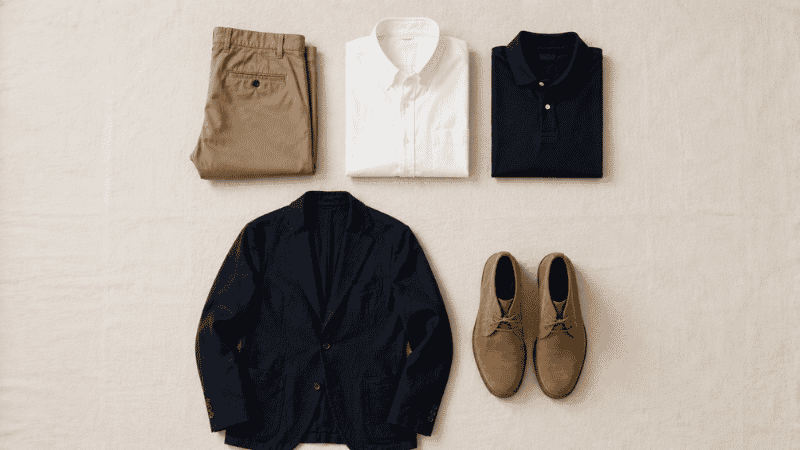
Once you know your office culture, building the wardrobe is simple. These five pieces—worn in different combinations—will carry you through virtually every business casual situation.
1. Chinos (Khaki or Navy)
The most reliable business casual pant. Medium-weight cotton twill, slim-to-straight fit, sitting cleanly at the shoe. Khaki is the classic choice. Navy reads slightly more formal and works well in more traditional offices.
What makes chinos work: they’re not jeans (which still reads casual to many), but they’re not dress trousers (which feels stiff). They occupy exactly the right middle ground.
In a law firm context: Pair with an Oxford shirt and leather shoes—you’re set. In a tech context: Pair with a polo and clean white leather sneakers—still professional, visibly relaxed.
2. The Oxford Cloth Button-Down Shirt (OCBD)
White or light blue. No loud patterns. The Oxford weave is heavier than a standard dress shirt and slightly textured, which means it looks intentional even when it’s not perfectly pressed. Wear it tucked for formal settings, loosely tucked or untucked for relaxed ones. Either way, it reads as business casual without much effort.
This is the single most useful shirt in a working man’s wardrobe. If you own one that fits well, you can walk into almost any professional environment and feel confident.
3. The Polo Shirt
Unfairly underestimated. A well-fitted polo in navy, white, or forest green—plain, no oversized logos—covers the vast majority of business casual situations. It’s more polished than a t-shirt, more relaxed than a button-down, and it works in both directions.
The important detail: it has to fit properly. A polo that’s too loose reads as a gym shirt. One that fits through the chest and shoulders, with sleeves ending at mid-bicep, reads as deliberate and clean.
4. The Unstructured Blazer
Optional in many offices, but the single fastest way to upgrade any outfit. An unstructured navy blazer—no heavy padding, no gold buttons—thrown over a polo or a tee instantly elevates the look without making you feel overdressed.
Keep one in your office if you can. Client drops by unexpectedly? Jacket on, done. The meeting you forgot about? Jacket on, done.
5. Clean Leather Shoes or Leather Sneakers
Shoes are where most men either finish the outfit or undo all the work above it. Business casual doesn’t require Oxford dress shoes—but it does require something with intention.
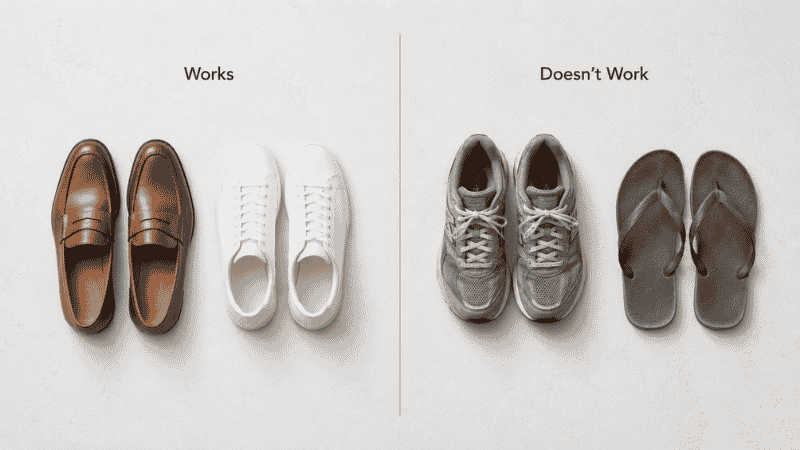
For traditional industries: loafers or chukka boots in brown or tan. For relaxed offices: clean white leather sneakers (low-top, minimal branding, kept pristine). Either direction works. What doesn’t work: running shoes, worn-down trainers, flip-flops, anything that looks like gym equipment.
Smart Casual vs. Business Casual: What’s the Actual Difference?
This comes up constantly, and the confusion is understandable—the terms sound nearly identical.
Smart casual is a social dress code. It’s what you wear to a dinner with friends, a casual date, or a weekend event where you want to look like you made an effort. Jeans are almost always fine here. A blazer is optional. Sneakers work.
Business casual is a professional dress code. It applies in workplaces, client meetings, and professional events. Jeans are acceptable in relaxed offices but questionable in traditional ones. The standard is slightly higher.
The practical difference: in smart casual, you’re dressing for yourself. In business casual, you’re dressing for the room—and the room has colleagues, clients, and people forming professional opinions of you.
One easy rule: if you’re not sure which applies, business casual is the safer default. You can always dress down if you walk in and everyone’s in jeans.
What Counts as Business Casual? (And What Definitely Doesn’t)
Always works:
- Chinos in khaki, navy, or grey
- Oxford shirts, button-down shirts, polo shirts
- Unstructured blazers
- Crewneck or V-neck sweaters over a collared shirt
- Loafers, chukkas, chelsea boots, leather sneakers
Works in relaxed offices, not traditional ones:
- Dark wash jeans (clean, no distressing)
- Untucked OCBD over chinos
- Well-fitted crewneck sweater worn solo
Doesn’t work in any business casual context:
- T-shirts (even nice ones)
- Athletic wear, hoodies, track pants
- Distressed or ripped denim
- Running shoes or worn trainers
- Baseball caps
- Shorts
- Anything with a large logo across the chest
One useful test before you leave the house: if you’d wear it to the gym, the beach, or a lazy Sunday at home, it’s probably not business casual.
The “I Have 10 Minutes” Business Casual Formula
Some mornings you don’t have time to think. Here’s the fastest route to a reliable business casual outfit:
Khaki chinos + Oxford shirt (tucked or loosely tucked) + leather shoes or clean leather sneakers.
That’s it. It works in almost every office environment, takes no deliberation, and looks like you made an effort. If you add a plain navy blazer, it upgrades to client-meeting level in under thirty seconds.
Build this combination once, know it works, and return to it every time your brain is moving slowly.
When Business Casual Still Isn’t Working
You’ve got the right pieces, you’re following the rules—but something still feels off. Usually, it’s one of three things.
The fit is wrong. This is the most common issue. A chino that’s too baggy reads as sloppy regardless of the fabric. An oxford shirt that balloons at the waist looks unintentional. Business casual relies on clothes that actually follow the lines of your body. If something doesn’t fit, no amount of “right pieces” will save it.
The colors are fighting. Neutral foundations (navy, white, grey, khaki) work together automatically. The moment you introduce a bright color or an unexpected pattern, you need to know how to manage it—and most men don’t. If you’re not confident with color, stay neutral. You won’t be boring; you’ll be consistent.
The shoes are killing it. Shoes communicate professionalism more than almost anything else at the waist-and-below level. Old trainers under chinos and an oxford shirt is a mismatch that reads immediately. The clothes say one thing; the shoes say another. Always resolve this in favor of the shoes.
FAQ
Can men wear jeans for business casual? It depends entirely on the office. In traditional industries—law, finance, formal corporate environments—jeans are generally not appropriate for business casual even if they’re dark and clean. In tech companies, startups, and creative agencies, dark wash slim jeans without distressing are usually fine. When in doubt on your first week at a new job, skip the jeans until you’ve read the room.
Is a polo shirt business casual for men? Yes, in most contexts. A well-fitted polo in a solid color—navy, white, grey, forest green—is a solid business casual choice. The fit matters: it should be close enough through the chest and shoulders to look intentional, not so tight it looks like you’re trying too hard. Avoid polos with large logos or graphics.
Can men wear sneakers for business casual? Clean leather sneakers—low-top, minimal branding, kept in good condition—work in most modern business casual environments. Running shoes, athletic trainers, or anything that looks like gym gear does not. When the office is more traditional, default to loafers, chukkas, or leather chelsea boots.
What’s the difference between business casual and smart casual? Smart casual is a social dress code for dinners, events, and casual occasions. Business casual is a professional dress code for work environments and client-facing situations. Smart casual has slightly more freedom with jeans and sneakers; business casual has a higher baseline for how polished you need to look.
Is it better to overdress or underdress when unsure? Overdress, always. You can take off a blazer or loosen a collar—there’s no way to add formality once you’ve walked in wearing the wrong thing. Showing up slightly overdressed in a professional context reads as respect and intention. Showing up underdressed reads as carelessness, which is the last impression you want to make.
Building Your Business Casual Wardrobe: Where to Start
If you’re starting from scratch or rebuilding, don’t try to buy everything at once. Start with the pieces that do the most work:
Week 1: One pair of khaki chinos, one Oxford shirt in white or light blue, one pair of leather shoes or clean leather sneakers. This covers you for 80% of business casual situations immediately.
Month 1: Add a navy polo, a second pair of chinos in navy or grey, and a plain unstructured blazer. Now you have enough variation that you’re not repeating the same combination every day.
Ongoing: A grey crewneck sweater, a second Oxford shirt in a different color, and a pair of chukka or chelsea boots will round out a wardrobe that handles every business casual scenario you’ll realistically encounter.
None of this requires a large budget. Fit matters more than brand. A $50 chino that fits correctly will always outperform a $200 one that doesn’t.
Final Thought
Business casual confuses people because it sounds specific but functions as a moving target. The dress code means something different depending on where you work, who you’re meeting, and what industry you’re in.
But the underlying logic is constant: look intentional, look polished, don’t make your clothes the thing anyone notices. Stick to neutral pieces that fit well, read your office culture before defaulting to any universal advice, and keep a blazer nearby for situations where you need to upgrade quickly.
Get those fundamentals right, and business casual stops being a question you have to think about every morning.
References
- Hazel Morley, VP of Design, Bonobos — Men’s Health, “Your One-Stop Guide to Business Casual Attire for Men”
- Joseph Rosenfeld, Image Consultant & Personal Stylist — Men’s Health, ibid.
- Matthew Cowley, Assistant Director for Professional Development, University of Florida Career Connections Center — UF Career Center, “So What Exactly Is Business Casual?”
Explore More on Modvello
- Capsule Wardrobe for Men: 10 Basics That Cover Every Situation (Wardrobe Basics)
- How Clothes Should Fit: The Complete Men’s Guide (Fit & Sizing)
- What to Wear to Work: Outfit Formulas for Every Office Type (Style by Occasion)
- Best Chinos for Men: Simple Picks That Fit Well and Last (Best Picks)
Last updated: June 2026 | Written by Daniel Ross