
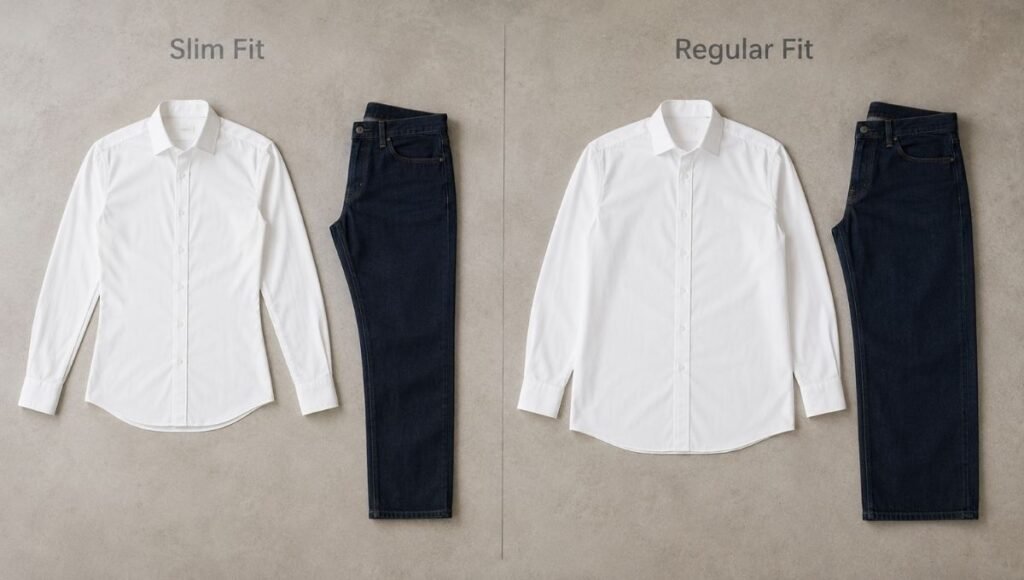
You’re standing in a dressing room with two identical shirts—one slim fit, one regular fit—and you genuinely cannot decide which one looks better. They both seem fine. They both seem slightly wrong. You’ve been in here for ten minutes and you’re no closer to an answer.
This is a situation most men have been in more than once, and it’s frustrating because the terminology sounds specific but rarely tells you what you actually need to know. “Slim fit” suggests tight. “Regular fit” suggests average. But a slim fit from Uniqlo fits completely differently from a slim fit from Gap, and “regular” at one brand is the equivalent of “relaxed” at another.
Here’s what actually matters: fit choice isn’t a universal answer. It depends on your body proportions, what you’re wearing the garment for, and—honestly—the specific brand you’re buying from. The men who always seem to dress well have figured out which cut works for their body and they default to it automatically, regardless of what’s trending.
This guide breaks down exactly what slim fit and regular fit mean, how to tell which one you should be wearing, and what changes across different garment types.
Key Takeaways
- Slim fit is cut closer to the body with less ease (extra room); regular fit has more room throughout
- Neither is objectively better—the right choice depends on your body proportions and the garment type
- Fit terminology is not standardized across brands—a “slim fit” from one brand may equal “regular fit” from another
- The MaleFashionAdvice community has shifted away from recommending slim fits as the default—straight and regular fits are now considered more versatile for most men
- Shorter men with athletic builds often find slim fits more proportional; taller men with average builds often find regular fits more flattering
What Is Slim Fit?
Slim fit is cut with less ease—less extra fabric—throughout the garment. For shirts, this means a narrower chest and torso, often with darts or side seams that taper inward. For trousers, it means less room in the seat and thigh, with a leg opening that’s narrower than regular fit.
The result: the garment follows the contours of your body more closely. On the right proportions, this looks sharp and intentional. On the wrong proportions, it creates tension across the chest, pulling at the buttons, or a trouser leg that restricts movement.
What slim fit is not: tight. A well-made slim fit garment that’s the correct size should never feel constrictive. If it does, you’re either in the wrong size or the wrong fit for your body.
Where slim fit works:
- Lean to average builds where the garment can follow the body without straining
- Shorter men for whom regular fit creates excess fabric that shortens the visual line of the body
- Business and smart casual contexts where a cleaner silhouette reads as more polished
- Shirts worn tucked in, where excess fabric creates unwanted bulk
What Is Regular Fit?
Regular fit—sometimes called classic fit, standard fit, or straight fit depending on the brand—has more ease throughout. More room in the chest, more room in the seat and thigh, a straighter cut from shoulder to hem in shirts and from hip to ankle in trousers.
The result: more comfort and movement, a more relaxed silhouette. It doesn’t necessarily look larger than slim fit when the proportions are right—it looks intentional in a different way.
Regular fit fell out of favor in the early 2010s when slim fit became the dominant recommendation in men’s style advice. But fashion moves in cycles. The MaleFashionAdvice community’s 2023 update explicitly notes that straight and regular fits are now recommended over slim cuts for most men, reflecting a broader shift toward more relaxed silhouettes across menswear.
Where regular fit works:
- Average to larger builds where slim fit would create tension or restriction
- Taller men for whom slim fit can look disproportionately tight through the torso
- Casual contexts where a relaxed silhouette feels appropriate
- Shirts worn untucked, where a slightly straighter hem falls more cleanly
The Key Difference Between Slim Fit and Regular Fit
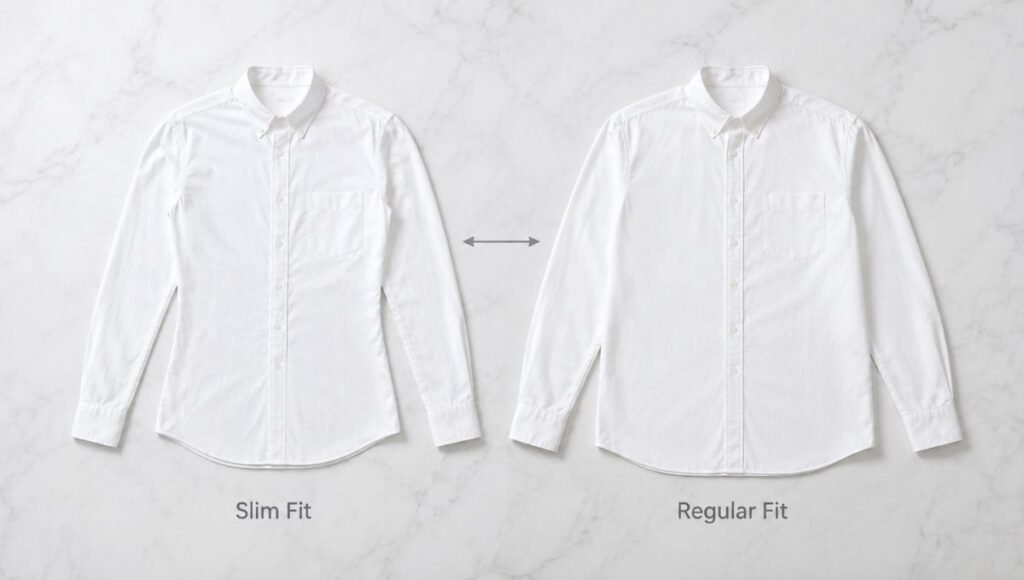
The clearest way to understand the difference is through specific measurements:
Chest: Slim fit typically runs 1–3 inches smaller across the chest than regular fit in the same labeled size. A slim fit Medium might measure 38″ across the chest; a regular fit Medium might measure 40–41″.
Waist (shirts): Slim fit shirts are more tapered at the waist—narrowing significantly from chest to hip. Regular fit shirts maintain a more consistent width, with minimal or no tapering.
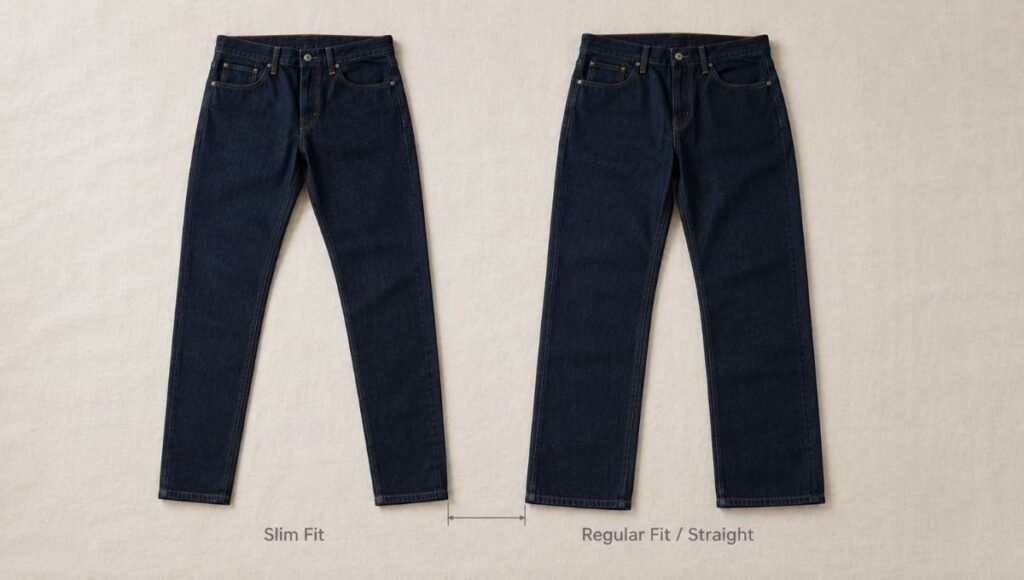
Seat and thigh (trousers): Slim fit trousers have less room through the seat and upper thigh. Regular fit has 1–4 more inches of ease in these areas, depending on the brand.
Leg opening (trousers): Slim fit has a narrower ankle opening than regular fit, creating a more tapered silhouette toward the hem.
One critical caveat: These numbers are not standardized. Different brands measure ease differently, which is why a slim fit from one brand can feel identical to a regular fit from another. Always check the brand’s specific size chart and—whenever possible—try before you buy.
Slim Fit vs Regular Fit: Which Is Better for Your Body Type?
This is the question most guides answer vaguely. Here’s a direct answer by body type.
Lean build (narrow shoulders, slim waist and hips)
Slim fit usually works better. With a lean build, regular fit tends to add visual bulk in areas where there isn’t much physical mass—the garment looks like it’s wearing you rather than the other way around. Slim fit follows the existing contours of a lean body and reads as proportional.
The exception: Very lean men who find slim fit too close to the body in the seat or thigh should try slim-straight, which tapers through the upper leg but has a consistent width below the knee.
Average build (moderate proportions throughout)
Either can work—context determines the choice. For professional environments and smart casual occasions, slim fit reads as more polished. For casual contexts, regular fit is appropriate and often more comfortable. The current trend suggests regular fit is the default, but this shouldn’t override what actually fits well on your specific proportions.
Athletic build (broader chest/shoulders, narrower waist; or broader thighs)
This is where standard advice fails. Men with athletic builds often find that slim fit strains across the chest and shoulders while regular fit is too large at the waist. The better solution is often an athletic fit (which has more room in the seat and thighs with a tapered leg) or a brand that designs for this proportion specifically.
For shirts: consider athletic cuts or brands that offer separate measurements. A slim fit shirt in a larger size often solves the shoulder/chest problem but creates excess fabric in the torso.
Shorter build (under 5’8″)
Slim fit generally reads as more proportional. This is the one context where the 2023 trend shift toward regular fits has a meaningful exception. As multiple men noted in the MaleFashionAdvice community discussions: shorter men in regular fits often look like they’ve borrowed clothes from someone larger. A slim fit creates cleaner vertical lines that work with a shorter frame rather than against it.
Taller build (over 6’1″)
Regular or straight fit often works better. Slim cuts can look disproportionately tight on a taller frame, particularly through the torso and thighs. Regular and straight fits tend to have proportions that scale better with taller bodies.
Slim Fit vs Regular Fit by Garment Type
The same general principles apply differently across different garments.
Shirts
The most common context for the slim vs regular debate. Slim fit shirts work well tucked in—the reduced volume creates less bulk under trousers. Regular fit shirts can look intentional untucked if the hem is designed for that wearing style.
One practical test: put the shirt on and raise your arms fully. In a slim fit, this shouldn’t create significant pulling across the chest or expose your midriff. If it does, the shirt is too slim or the wrong size.
Jeans and Trousers
The 2023 shift in the MaleFashionAdvice community specifically calls out slim fit trousers as no longer the recommended default, suggesting straight fit instead. The reasoning: straight cuts are more versatile across body types and occasions, and the extra room is rarely a styling problem when the garment fits correctly at the waist and seat.
For most men, slim-straight (fitted through the seat and thigh, straight leg below the knee) is the best of both approaches—it avoids the excess fabric of wide cuts without the restriction of narrow slim cuts.
Suits and Blazers
The fit terminology for suits follows the same principles but with specific structural implications. Slim fit suits are cut with a higher button stance, narrower lapels, and a shorter jacket length. Regular fit suits have a more traditional structure with wider lapels and more room throughout.
The current direction in menswear: suit fit has moved away from the very slim cuts of the early 2010s toward something between slim and regular—a fitted look that doesn’t restrict movement. For most men buying a suit, this middle ground (sometimes called “modern fit” or “tailored fit”) is the most versatile choice.
The Honest Answer to “Which Should I Wear?”
Stop trying to make a universal decision and start asking: what fits my body correctly right now?
The right fit is the one where the shoulder seam sits exactly at your shoulder bone, the chest skims without pulling, the seat follows your shape without excess bunching, and you can move normally. Whether that garment is labeled slim fit or regular fit is secondary.
The practical process: try both in the same brand in the same size. Look at the result objectively. One will fit better at more points simultaneously. That’s your fit for that brand.
Then, when you find a fit that works in a specific brand, write it down. “Uniqlo slim fit medium” or “Gap regular fit large.” Shopping becomes significantly simpler when you’re not guessing from scratch each time.
FAQ
What is the difference between slim fit and regular fit? Slim fit has less ease—less extra fabric—throughout the garment, sitting closer to the body with a more tapered silhouette. Regular fit has more room throughout, with a straighter cut from shoulder to hem in shirts and hip to ankle in trousers. In practical terms, slim fit reads as more polished and structured; regular fit is more comfortable and relaxed. The difference in measurements is typically 1–3 inches across the chest and 1–4 inches through the seat and thigh.
Should I wear slim fit or regular fit? It depends on your body proportions. Lean builds and shorter men typically find slim fit more proportional. Taller men and those with average builds often find regular fit more flattering. Men with athletic builds (broader chest, broader thighs) often struggle with both and do better with an athletic or tapered fit. Try both in the same brand and choose based on which fits correctly at the most points—shoulder seam, chest, seat, and thigh.
Is slim fit going out of style? The MaleFashionAdvice community’s 2023 style update suggests that very slim cuts are no longer recommended as the default, with straight and regular fits now considered more versatile and contemporary. However, this is a trend observation rather than a rule—what matters more is what fits your body correctly. Slim fits haven’t disappeared; the extreme skinny cuts of the early 2010s have, but fitted slim cuts remain widely worn and appropriate.
Is slim fit tighter than regular fit? Yes, slim fit has less ease (extra room) than regular fit, which means it sits closer to the body. However, a correctly sized slim fit garment should not feel tight or restrictive—it should follow your body without pulling or straining. If a slim fit garment feels tight, you’re either in the wrong size or this fit isn’t appropriate for your proportions.
What does regular fit mean in men’s clothing? Regular fit (also called classic fit, standard fit, or straight fit depending on the brand) means the garment has a more traditional, relaxed amount of extra room—more ease—throughout. It’s designed to accommodate a range of body proportions without fitting very closely to the body. It doesn’t mean oversized or baggy; a correctly sized regular fit garment should still fit properly at the shoulders and chest.
References
- MaleFashionAdvice Substack, “How the Basic Wardrobe Has Changed: A 2023 Supplement” — updated community guidance on fit types and the shift from slim to regular/straight cuts
- MaleFashionAdvice Substack comments (2023) — community discussion on how fit recommendations interact with height and body type
- Restart Your Style, “Slim Fit vs Regular Fit: Which Should You Choose?” (2025) — practical comparison of fit types across garment categories
- The Trend Spotter, “Slim Fit vs Regular Fit: What’s Right For You?” (2026) — body type recommendations and measurement differences
Explore More on Modvello
- How Should Jeans Fit Men? The Complete Fit Guide for Every Cut (Fit & Sizing)
- Men’s Clothing Size Chart: How to Measure and Find Your Perfect Fit (Fit & Sizing)
- Men’s Wardrobe Essentials: What to Buy, What to Skip, and Where to Start (Wardrobe Basics)
- How to Dress Better: The Practical Men’s Style Guide (Wardrobe Basics)
- Capsule Wardrobe for Men: 10 Basics That Cover Every Situation (Wardrobe Basics)
Last updated: June 2026 | Written by Daniel Ross