Here’s the thing about buying jeans: it should be simple. It isn’t.
You know your waist size. You know your inseam. And yet you’ve stood in fitting rooms trying on four pairs of the same size from the same brand and had them all feel different. You’ve ordered online, had them arrive looking exactly right in photos and exactly wrong on your body. You’ve found a pair that fits perfectly, worn them for two years until they wore out, gone back to buy the same pair, and discovered the brand changed the cut.
Jeans are the one item in men’s wardrobes where the gap between “finding what works” and “finding what you actually wanted” feels widest. And the reason is straightforward: most jeans guides give you a list of what to buy without helping you understand what will fit your specific body.
This guide does both. A buying framework that covers what actually determines fit quality, followed by specific recommendations at three price tiers — with clear guidance on which fits work for which body types.
Key Takeaways
- The best men’s jeans depend on body type as much as brand — a slim fit jean that works on a lean build can be unwearable on an athletic one
- Stretch denim (1-3% elastane) significantly improves comfort and fit retention without compromising the look of traditional denim
- Levi’s 511 remains the most reliable slim fit jean under $70 — tested across multiple body types and widely available
- DUER Performance Denim is the most consistently recommended mid-range option across men’s style communities for its stretch-to-style balance
- Dark indigo and black are the two most versatile washes — both work across casual and smart casual contexts without looking too casual
What Makes a Good Pair of Men’s Jeans
Before the brand recommendations, the framework. Because the reason most men end up with jeans that don’t quite work isn’t that they bought the wrong brand — it’s that they didn’t know what to look for.
Denim Weight and Fabric
Denim is measured in ounces per square yard. Lighter denim (10-11oz) feels softer and drapes more — better for slim cuts and warmer weather. Mid-weight (12-13oz) is the standard for most everyday jeans — substantial enough to hold its shape, light enough to be comfortable. Heavier denim (14oz+) is for raw denim enthusiasts who want denim that ages visibly over years of wear.
For most men buying jeans to wear regularly: mid-weight, with 1-3% elastane blended in. The elastane adds stretch that makes a significant difference in comfort during long days without visibly changing how the jeans look.
The Stretch Question
Traditional denim has no stretch. Modern jeans almost universally blend in a small percentage of elastane or polyester for comfort. The difference between 0% stretch and 2% stretch is substantial — the latter moves with you rather than against you.
The concern most men have about stretch denim: that it will lose its shape and bag out at the knees. This is a real issue with low-quality stretch blends. Quality stretch denim — Mott & Bow, DUER, and similar brands — uses fabrics engineered to return to shape after stretching. The key indicator is whether the brand specifies “stretch recovery” in their fabric description.
Wash and Color
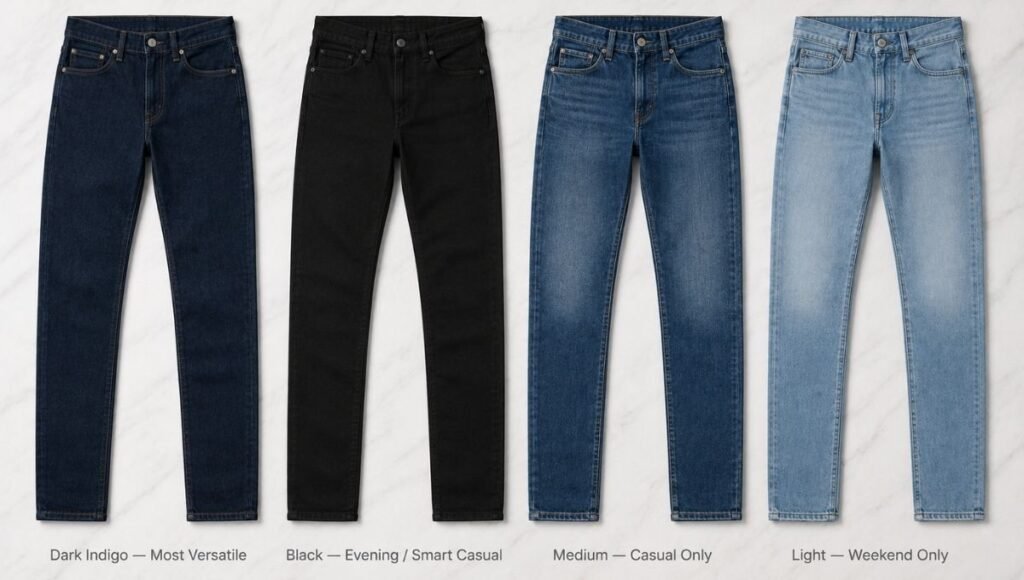
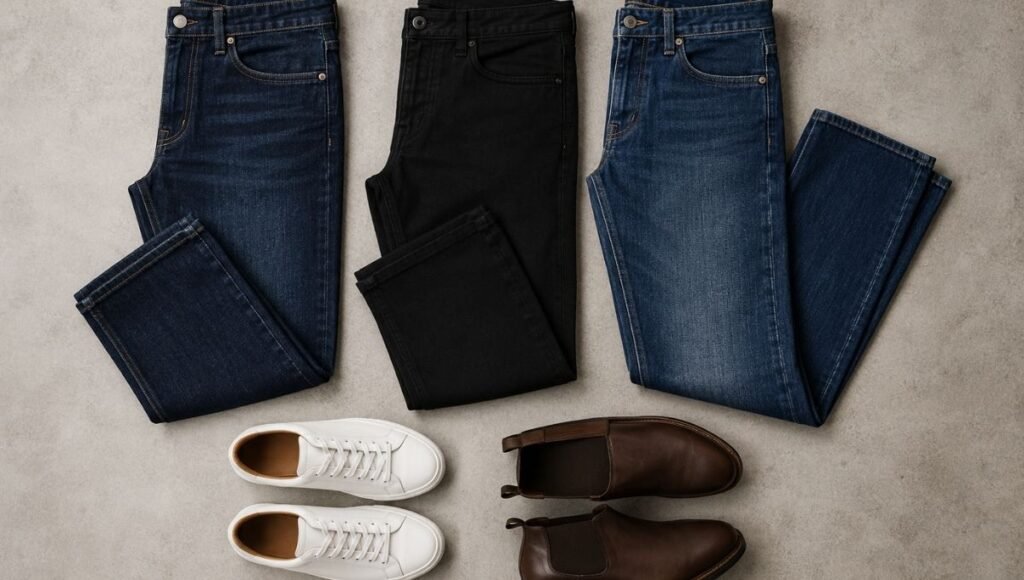
Dark indigo: The most versatile wash. Reads as semi-formal in smart casual contexts; reads as casual in everyday ones. Works with every shoe type from white leather sneakers to leather dress shoes.
Black: Slightly more formal-reading than dark indigo. Pairs particularly well with evening smart casual combinations. Doesn’t fade as distinctly as indigo, which means it looks consistent for longer.
Medium wash: Classic American denim look. Works best in genuinely casual contexts — less appropriate than dark indigo for smart casual situations.
Light wash: The most casual of the standard washes. Reserve for weekend and relaxed situations.
For a first or only pair of dark jeans: dark indigo. For a second pair: black. Medium and light washes are additions once the foundation is established.
The Best Men’s Jeans by Body Type
This section is what most guides skip — and it’s the part that actually determines whether a pair of jeans works for you.
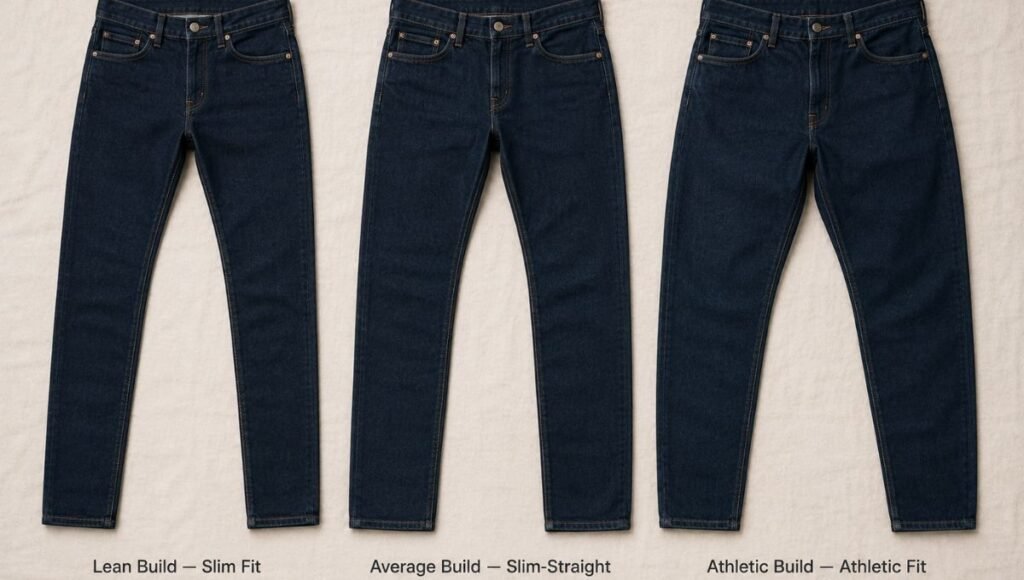
Lean Build (Narrow Hips and Thighs)
Best fit: Slim or slim-straight
Slim cuts follow a lean body without excess fabric — the proportions read as clean and intentional. Slim-straight (fitted through the seat and thigh, straight leg below the knee) gives slightly more room in the lower leg for men who find slim cuts too restrictive there.
What to avoid: Relaxed or straight fits — they create excess fabric in the seat and thigh that reads as ill-fitting on a lean frame.
Recommended: Levi’s 511 (slim), Uniqlo Slim Fit Jeans, Mott & Bow Slim
Average Build (Proportional Waist-to-Thigh Ratio)
Best fit: Slim-straight or straight
The current consensus in men’s style communities has moved away from very slim fits toward straight and slim-straight cuts as the most flattering for average proportions. A straight fit that fits correctly through the seat reads as modern and clean.
What to avoid: Very slim or skinny cuts — they can look proportionally off on an average build if the thighs are at all wider than the slim cut accommodates.
Recommended: Levi’s 514 (straight), DUER No Sweat Pant Slim, Mott & Bow Straight
Athletic Build (Broader Thighs and Seat, Narrower Waist)
Best fit: Athletic fit or tapered fit
This is the most underserved segment in men’s denim. Standard slim cuts strain across the thighs and seat while fitting the waist correctly — or fit the thighs correctly while leaving the waist too loose. Athletic fit jeans solve this with extra room through the seat and thigh that tapers below the knee.
<cite index=”19-1″>Men with bigger legs who often struggle to find jeans that fit right do best with athletic fit options specifically designed for broader thigh and glute proportions, with a gusseted inseam that prevents blowouts and provides more mobility.</cite>
Recommended: Mugsy Jeans (built for athletic builds), Levi’s 541 Athletic Fit, Barbell Apparel Athletic Fit, DUER Performance Denim (accommodates athletic thighs with stretch)
Shorter Build (Under 5’8″)
Best fit: Slim or slim-straight, with attention to inseam
Proportional denim for shorter men means avoiding excess fabric at the ankle — which means either finding brands that offer 28-29″ inseam options or planning to hem standard 30″ inseams.
Recommended: Ash & Erie (specifically designed for shorter men), Levi’s 511 in shorter inseams, Uniqlo (offers varied inseam lengths)
Taller Build (Over 6’1″)
Best fit: Straight or slim-straight, with long inseam options
Taller men need reliable 34″+ inseam options, which eliminates some brands that only stock standard lengths. Straight fits tend to scale better with taller proportions than slim cuts.
Recommended: American Eagle (offers tall sizes), Levi’s (offers long inseam variants), Gap (tall options available)
The Best Men’s Jeans: By Budget
Under $70: Best Value
Levi’s 511 Slim Fit ~$50–70 | Dark indigo or black | Multiple inseams
<cite index=”19-1″>Levi’s 511 slim jeans offer classic American denim with a modern slim cut that works for almost everyone under $100.</cite> The 511 has remained one of the most consistently recommended affordable slim jeans across men’s style communities for years — not because it’s trendy, but because the fit is reliable, the sizing is predictable, and it’s available everywhere, which makes finding your exact size significantly easier than with smaller brands.
The fabric is standard mid-weight denim without significant stretch — adequate for most daily situations but less comfortable than stretch-blend options at higher price points.
Best for: Men who want a reliable slim fit at minimum investment. The go-to recommendation for men who aren’t sure what they want yet.
Uniqlo Slim Fit Jeans ~$40–50 | Multiple washes | Multiple inseams
Uniqlo’s denim consistently punches above its price point. The slim fit sits between a true slim and a slim-straight — slightly more room than Levi’s 511 in the thigh, which works better for men who find the 511 too restrictive. The fabric quality at this price is notable.
Best for: Men who find the 511 too slim, or who want slightly more room in the thigh while maintaining a clean silhouette.
Levi’s 541 Athletic Fit ~$60–70 | Dark indigo | Multiple inseams
For men with athletic builds who’ve consistently found slim and straight cuts restrictive, the 541 is the most accessible option. More room through the seat and thigh, tapering below the knee. The fit accommodation for athletic proportions is meaningful without making the jeans look baggy.
Best for: Athletic builds who’ve struggled with standard cuts. Men who lift, play sports, or generally have thighs that strain against slim fit denim.
$70–$120: Best Overall Value
DUER Performance Denim ~$89–109 | Multiple washes and fits
<cite index=”21-1″>DUER jeans are incredibly comfortable, packed with features, and available in a wide variety of styles — and they don’t look technical.</cite> The Performance Denim line uses a stretch fabric that accommodates movement significantly better than standard denim while looking indistinguishable from traditional jeans. The stretch recovery is strong — they don’t bag at the knees with regular wear.
DUER is the recommendation that comes up most frequently when men ask for jeans they can wear from a work-from-home desk situation through a smart casual evening without changing. That versatility is genuine.
The honest limitation: At $89-109, they’re a step up from Levi’s pricing. The stretch and durability justify it for daily wear, but for occasional-wear jeans, Levi’s makes more economic sense.
Best for: Men who want jeans they can wear all day, every day, across multiple contexts. Active men. Men who sit for long periods at a desk.
Mott & Bow Slim or Straight ~$119 | Multiple washes | Multiple fits
<cite index=”20-1″>Mott & Bow uses premium Italian and Turkish denim with up to 35% stretch for all-day comfort, and prices start at $119 for men — which beats many luxury denim brands.</cite> The Mercer and Bedford fits are consistently praised for their combination of dress-adjacent polish and denim comfort.
<cite index=”20-1″>With proper care — cold wash, hang dry, wash only when needed — Mott & Bow jeans last two to four years of regular wear.</cite>
Best for: Men who want the look and feel of dress trousers with the comfort of denim. Smart casual environments where dark denim reads as intentional rather than casual.
$120+: Best Quality
Buck Mason Japanese Loomstate Selvedge ~$178–228 | Indigo | Classic cuts
For men who want denim that ages and fades into something that looks uniquely worn-in over years rather than degrading, selvedge denim from a quality source is the answer. Buck Mason’s Japanese denim uses high-quality cotton that fades distinctively with wear — a different proposition than standard denim, which fades randomly.
The honest note: This isn’t a recommendation for everyone. Selvedge denim requires more care, breaks in over time, and the value proposition is for men who wear the same pair of jeans most days for years. For occasional wear or men who prefer consistent color, standard denim at a lower price point makes more sense.
Best for: Men who want jeans that develop character with wear. Daily denim wearers who want one excellent pair rather than several adequate pairs.
How to Make Your Jeans Last Longer
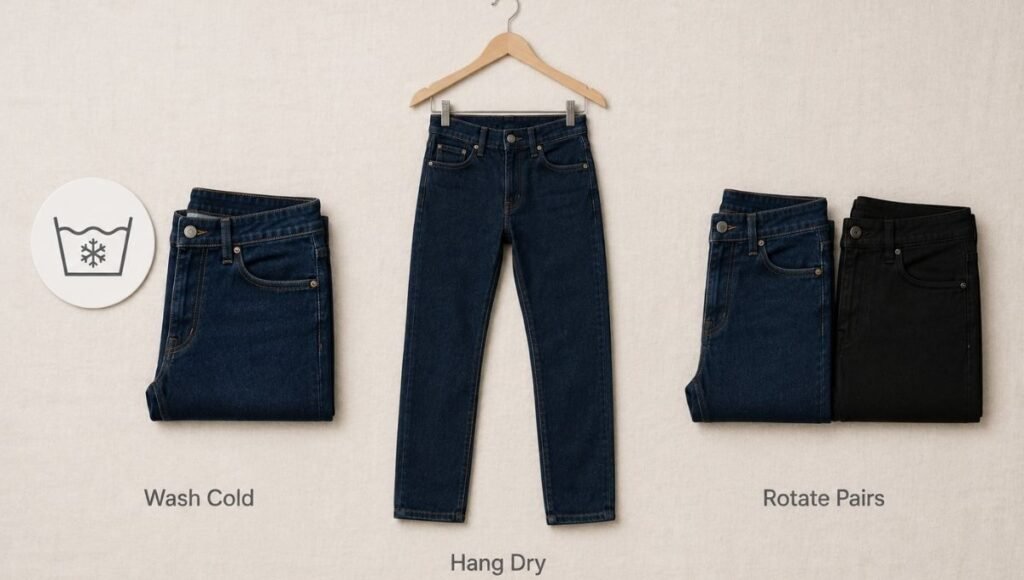
The three habits that determine how long any pair of jeans lasts:
Wash infrequently. Denim doesn’t need to be washed after every wear — it needs to be washed when it’s visibly dirty or genuinely odorous. <cite index=”20-1″>Washing only when needed, combined with cold wash and hang dry, significantly extends jeans lifespan.</cite> Most denim enthusiasts wash their jeans every 10-20 wears.
Cold wash only. Hot water degrades denim fabric and causes fading and shrinkage. Cold wash handles cleaning effectively without the damage.
Hang dry. Tumble drying is the fastest way to degrade denim. Hang drying after cold washing keeps the fabric in significantly better condition.
Rotate between pairs. If you wear jeans daily, owning two pairs and alternating extends the lifespan of both. Denim needs time to recover its shape between wears.
FAQ
What are the best men’s jeans to buy? For most men: Levi’s 511 (slim fit, under $70) for a reliable affordable option; DUER Performance Denim (~$99) for the best everyday comfort at mid-range; Mott & Bow (~$119) for the smartest-looking dark denim. The best jeans for you depend on your body type and how you plan to wear them — athletic builds should start with the Levi’s 541 or Mugsy rather than standard slim cuts.
What jeans brands are best for men? Levi’s remains the most reliable accessible brand with the widest size availability. DUER and Mott & Bow lead the mid-range for quality and comfort. For athletic builds specifically, Mugsy and Barbell Apparel are the most recommended options. For quality denim that ages well, Buck Mason and Iron Heart address the premium market.
What is the best fit for men’s jeans? Slim-straight is currently the most recommended fit for most body types — fitted through the seat and upper thigh with a straight (non-tapering) leg below the knee. It’s more modern than straight fit and more comfortable than slim fit. Athletic fit is specifically recommended for men with broader thighs and seat proportions who consistently find slim and straight cuts restrictive.
How much should men spend on jeans? The cost-per-wear math generally favors spending more on jeans you’ll wear daily. A $100 pair worn 250 days per year for three years costs $0.13 per wear; a $50 pair that wears out in 18 months of similar use costs $0.11 per wear — similar cost but lower quality throughout. For daily-wear jeans, $70-120 is the sweet spot. For occasional-wear jeans, Levi’s at $50-70 makes more economic sense.
What jeans look good for smart casual men’s outfits? Dark indigo or black slim-straight jeans. The dark wash is what allows jeans to read as smart casual rather than purely casual — light or medium wash jeans, regardless of fit, look casual in most contexts. Pair dark jeans with leather shoes or loafers (not white sneakers) and a tucked Oxford shirt or blazer for the combination to fully register as smart casual.
References
- Gentleman Within, “25 Best Jeans Brands for Men in 2025” — comparative testing across Levi’s, Mott & Bow, DUER, and American Eagle with fabric and comfort analysis
- The Mr. Boo, “Best Jeans for Men: 15 Pairs Ranked and Reviewed” — athletic build recommendations and body type matching framework
- We Tried It, “Best Men’s Jeans” — DUER, Mugsy, and Mott & Bow extended wear testing
- StyleSense, “Mott and Bow Jeans Review 2026” — durability and longevity data for mid-range premium denim
Explore More on Modvello
- How Should Jeans Fit Men? The Complete Fit Guide for Every Cut (Fit & Sizing)
- Men’s Clothing Size Chart: How to Measure and Find Your Perfect Fit (Fit & Sizing)
- Slim Fit vs Regular Fit: What’s the Difference and Which Should You Wear (Fit & Sizing)
- What to Wear With Black Pants: The Men’s Complete Outfit Guide (Outfit Ideas)
- The Best Chinos for Men: Honest Picks at Every Budget (Best Picks)
Last updated: June 2026 | Written by Daniel Ross