Monday morning. You’re running slightly behind. You open your closet and stare at it for longer than you should, then grab something that feels vaguely office-appropriate and spend the commute wondering if you’re underdressed.
This happens to most men more often than they’d admit. Not because they don’t own clothes—they usually own plenty—but because they’ve never built a deliberate system for what they wear to work. Every morning becomes a small decision that shouldn’t require as much mental energy as it does.
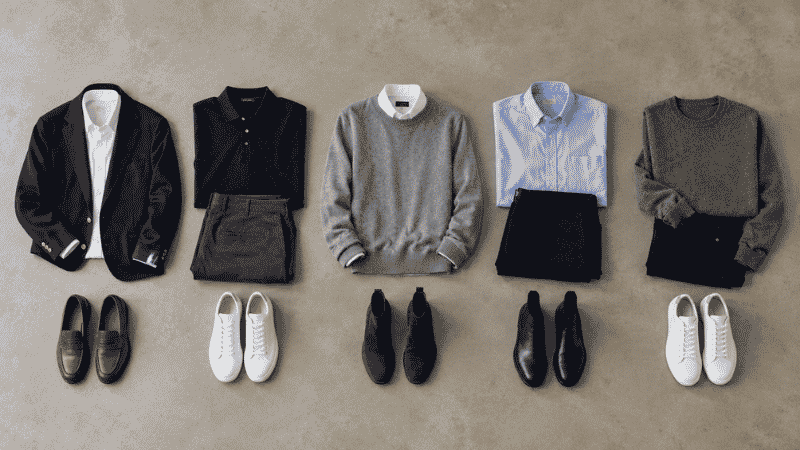
The fix isn’t buying more. It’s building five reliable casual work outfits for men that you can rotate through the week on autopilot. Once those formulas are in place, you stop deciding and start just getting dressed.
This guide gives you exactly that: five specific outfit combinations, calibrated for different office environments, with clear instructions on what to wear and when to wear it.
Key Takeaways
- Five outfit formulas cover a full work week without repeating combinations
- The right formula depends on your office type—traditional, modern/tech, or creative—not just personal preference
- Research from Northwestern University confirms that clothing influences cognitive performance and professional self-perception (“enclothed cognition”)
- A blazer is the single highest-leverage piece for casual office dressing—it upgrades any combination in under thirty seconds
- Shoes matter more in office contexts than almost anywhere else—worn footwear undermines any outfit above it
Before the Outfits: Know Your Office Type
The biggest mistake men make with casual work outfits is applying generic advice to a specific context. “Business casual” means something different in a law firm than in a product company, and what works in one environment can read as either too formal or too relaxed in another.
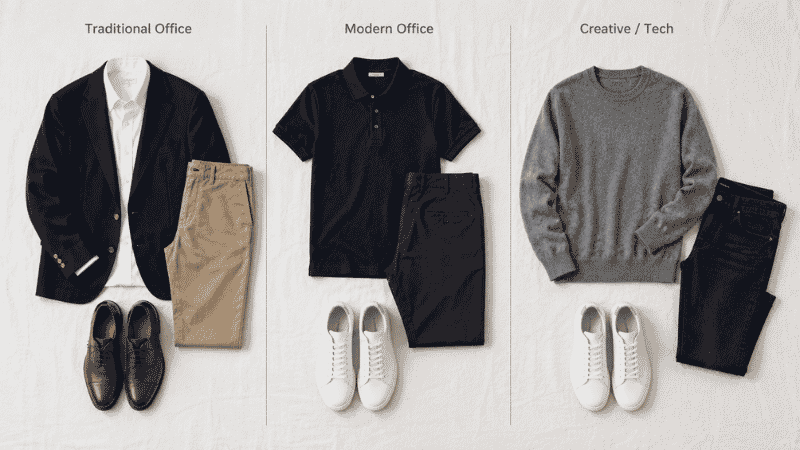
Traditional / Corporate Office (finance, law, consulting, corporate banking): Business casual here skews formal. Chinos over jeans, always. Oxford shirt or polo, not a t-shirt. A blazer is rarely wrong and often expected. Leather shoes or smart loafers—not sneakers.
Modern / Mid-Size Professional (marketing agencies, mid-size tech, professional services): This is where most style guides aim. Oxford shirt, polo, or a neat crewneck. Chinos or dark jeans both work. Blazer optional but useful for meetings. Clean leather sneakers are acceptable.
Tech / Startup / Creative (product companies, startups, design studios): The baseline is higher than pure casual but lower than traditional business casual. Dark jeans, neat polo or crewneck, clean sneakers. A blazer signals you’re in client-facing mode. Overformal can work against you here.
Identify which category your office falls into. The five outfits below cover all three—with notes on which environments each one fits best.
5 Men’s Casual Work Outfits for the Full Week
Monday: The Authority Start
The combination: Navy unstructured blazer + white Oxford shirt + khaki chinos + tan leather loafers
Monday sets the tone. This outfit does that reliably—it reads as intentional and professional without being overdressed. The navy blazer provides structure; the Oxford shirt signals effort without formality; the khaki chinos keep it grounded.
The authority this combination projects isn’t about looking stiff—it’s about looking like you made a considered choice. That’s enough to start the week on the right foot in almost any office environment.
Calibration by office type:
- Traditional: Add a silk tie. Swap loafers for cap-toe Oxfords.
- Modern professional: Wear as described. Leave the jacket on through morning meetings, remove it in the afternoon if the vibe loosens.
- Tech/Creative: Swap khaki chinos for dark jeans. Swap loafers for clean white leather sneakers.
The one detail that makes it work: Keep the Oxford shirt tucked. An untucked Oxford under a blazer reads as deliberate on weekends; in an office on Monday, it reads as unfinished.
Tuesday: The Reliable Middle
The combination: Light blue or white polo shirt + navy or charcoal chinos + white leather sneakers or brown suede loafers
Tuesday is where most men default to repetition—they reach for something close to Monday’s outfit or pivot too far toward casual. The polo solves this. It’s more relaxed than a button-down but more polished than a t-shirt, and it works without a jacket in most modern office environments.
A solid-color polo in navy, white, forest green, or light blue—no large logos—reads as intentional in most casual office contexts. The navy or charcoal chinos (darker than khaki) add slightly more visual weight, which keeps the overall look from feeling too relaxed without the polo having to do all the work.
Calibration by office type:
- Traditional: Add a blazer over the polo. Swap sneakers for loafers.
- Modern professional: Wear as described. This is the sweet spot.
- Tech/Creative: Swap chinos for dark slim jeans. Sneakers are fine.
The detail most men miss: Polo shirt fit through the chest and shoulders matters more than almost any other garment. A polo that’s slightly too loose reads as a gym shirt regardless of the brand or price. Get one that’s fitted—not tight, fitted.
Wednesday: The Smart Layer
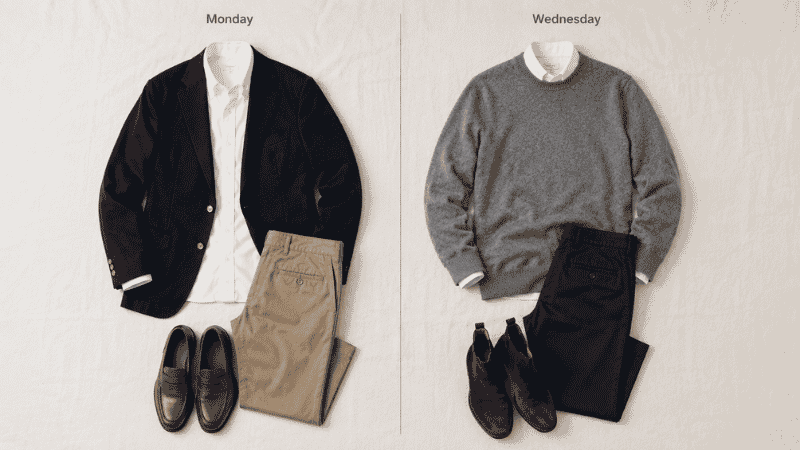
The combination: Grey crewneck sweater + white or light blue Oxford shirt underneath (collar showing) + dark chinos + chelsea or chukka boots
Midweek is where the routine starts to feel stale, and this combination solves that without requiring a completely different approach. The layered crewneck-over-Oxford creates visual depth through texture contrast without adding complexity to the process of getting dressed.
The Oxford collar showing above the sweater neckline is the detail that makes it look deliberate. Without the collar, it’s just a sweater and chinos. With it, there’s clear evidence that something is happening underneath—which reads as thought-out rather than thrown-together.
Calibration by office type:
- Traditional: Keep the blazer handy for morning meetings. Button-up the Oxford underneath.
- Modern professional: Wear as described. Boots are the finishing piece that elevates this.
- Tech/Creative: Swap oxford for a plain white tee underneath if the collar detail feels too formal for your environment.
Season adjustment: In warmer weather, a lightweight merino crewneck works better than heavier cotton. In summer, this combination may be too warm—pivot to the Tuesday or Friday formulas instead.
Thursday: The Workwear Sharp
The combination: Oxford cloth button-down shirt (blue or white) + dark slim-straight trousers or dress chinos + leather chelsea boots + no jacket
By Thursday, the week’s routine is established and you want something that looks sharp without the weight of Monday’s blazer. The OCBD-over-trousers combination does exactly that—it reads as professional and intentional without requiring a layer.
The key differentiation from Tuesday is the trouser upgrade: not chinos, but dress chinos or slim-cut formal trousers in charcoal, dark navy, or dark grey. These read as closer to business formal than casual, which elevates the overall look even with just a shirt on top.
Calibration by office type:
- Traditional: This outfit calls for a blazer or at least a sport coat in a traditional environment. Add one for any meeting context.
- Modern professional: Wear as described. This is a strong look for Thursday client calls or presentations.
- Tech/Creative: Swap dress trousers for dark slim jeans. Chelsea boots remain.
The tactical move: Thursday is often meeting-heavy as teams wrap up the week’s work. This combination handles meetings and desk time equally well, which makes it the pragmatic choice for a busy late-week day.
Friday: The Intentional Casual
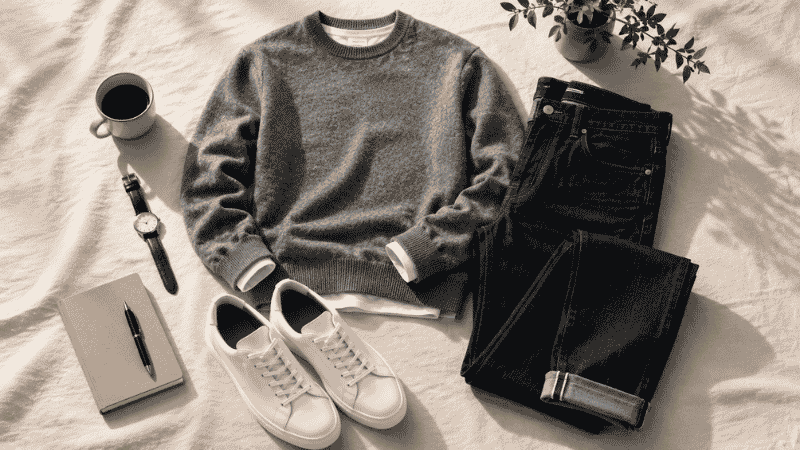
The combination: Grey or navy crewneck sweatshirt (clean, structured) OR quarter-zip in navy + dark slim jeans + white leather sneakers
Casual Friday is where most men either give up entirely (old t-shirt, worn jeans, gym shoes) or feel uncertain about how casual is too casual. The answer is: intentional casual is different from careless casual.
A structured crewneck in a solid neutral—not a worn-out hoodie, not a graphic tee, but a clean knit in charcoal or navy—with slim dark jeans and white leather sneakers is intentional. It says “I know it’s Friday and I dressed accordingly” rather than “I stopped trying.”
The quarter-zip is an alternative that sits slightly higher on the formality scale—good for offices where Friday is casual but still client-facing.
Calibration by office type:
- Traditional: Friday casual in a traditional office still means chinos and a collared shirt at minimum. This Friday formula is for modern and creative environments.
- Modern professional: Wear as described. This is Friday.
- Tech/Creative: You can go slightly more relaxed here—a well-fitted tee under the crewneck works.
The line not to cross: Graphic tees, visibly worn jeans, athletic shoes, and hoodies signal that you disconnected from work before Friday ended. Even in the most casual offices, keeping the outfit clean and neutral reads as respectful of the space.
The 5-Minute Emergency: When You Have No Time
Some mornings the system breaks down. Here’s the fastest route to an acceptable office outfit:
Dark chinos + Oxford shirt (any color) + leather loafers.
Three items. Five minutes. Works in every office environment except the strictest formal contexts. Tuck the shirt, make sure the chinos are clean, keep the shoes polished. That’s the floor. Everything else is above it.
When the Outfit Isn’t Working at the Office
You feel underdressed once you arrive. The blazer is your emergency upgrade. If you don’t have one at your desk, consider keeping a navy one on the back of your chair or in a drawer. It changes the register of any outfit in under thirty seconds.
You feel overdressed compared to colleagues. Remove the jacket. Untuck the shirt slightly. The outfit becomes less formal immediately without changing any pieces.
The clothes are right but something still feels off. Usually footwear. Office casual outfits live and die by the shoes. Worn soles, scuffed toes, athletic trainers—these single factors drag any combination down. A clean pair of leather shoes or leather sneakers fixes most “something feels wrong” situations.
FAQ
What are good casual work outfits for men? The most reliable casual work outfit combinations for men are: Oxford shirt + chinos + loafers (traditional offices), polo shirt + dark chinos + clean sneakers (modern offices), and crewneck sweater + Oxford underneath + chelsea boots (any office in cooler weather). All three read as intentional and professional without being overdressed.
Can men wear jeans to a casual office? Dark wash, slim-straight jeans without distressing work in most modern and creative offices for business casual. In traditional offices—finance, law, formal corporate environments—jeans typically remain too casual even on Fridays. When uncertain, default to chinos until you’ve had a chance to observe what colleagues and managers wear.
What shoes should men wear for casual work outfits? Clean leather loafers (tan or brown) and white leather sneakers are the two most versatile options for casual office wear. Loafers read slightly more formal and work in traditional contexts; white leather sneakers work in modern and creative environments. Either direction works—the key is that they’re kept clean and in good condition.
How do men dress business casual without a blazer? An Oxford shirt or polo with well-fitted chinos and clean leather shoes reads as business casual in most modern office environments without a blazer. The key is that the shirt be a structured collared piece (not a t-shirt), the trousers be clean and well-fitting, and the shoes be leather rather than athletic. The absence of a blazer is fine in most casual workplaces; the absence of a collar or structured trouser is not.
What’s the difference between casual work outfits and smart casual? Casual work outfits are calibrated for professional environments with a relaxed dress code—the bar is higher than true casual. Smart casual sits between business casual and casual, allowing more personality and flexibility. In practice: casual work outfits typically require a collared shirt and leather shoes at minimum; smart casual allows for a neat tee, cleaner sneakers, and more personal expression. Both are above “jeans and a t-shirt.”
References
- Adam, H., & Galinsky, A. D. (2012). “Enclothed Cognition.” Journal of Experimental Psychology: General, 141(4), 997–1006 — foundational research on how clothing influences professional self-perception and cognitive performance
- TheBetterFit, “30 Men’s Business Casual Outfits That Actually Work at Work” (2026) — curated outfit formulas for modern office environments
- Style Girlfriend, “A Week of Men’s Spring Business Casual Outfits” (2025) — week-long outfit rotation reference for contemporary business casual
Explore More on Modvello
- Business Casual Dress Code for Men: What It Actually Means (Wardrobe Basics — the definition guide that pairs with this one)
- How to Dress Better: The Practical Men’s Style Guide (Wardrobe Basics)
- Capsule Wardrobe for Men: 10 Basics That Cover Every Situation (Wardrobe Basics)
- How to Wear Chinos: Men’s Outfit Ideas From Office to Weekend (Outfit Ideas)
- The Best Chinos for Men: Honest Picks at Every Budget (Best Picks)
Last updated: June 2026 | Written by Daniel Ross