
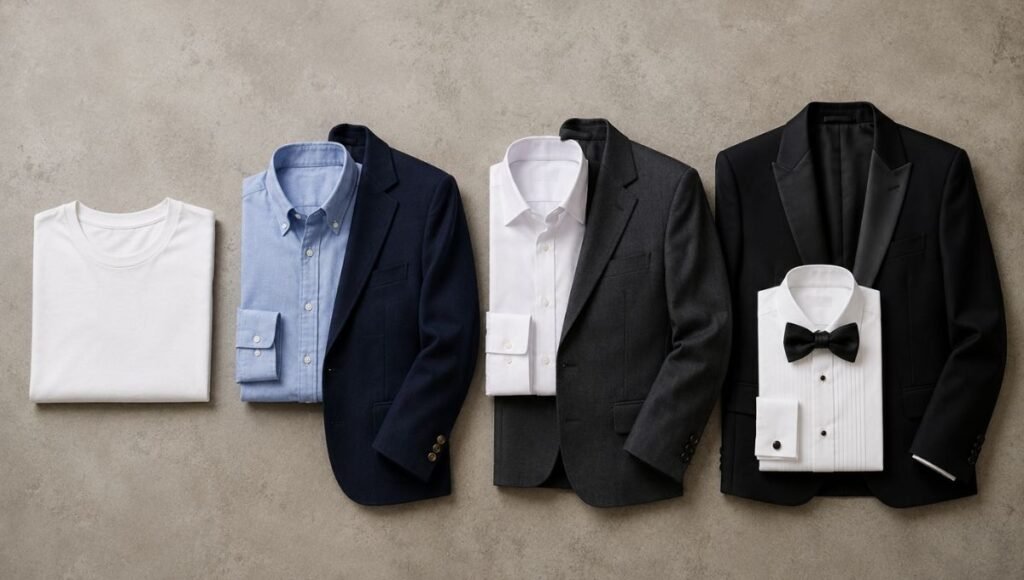
You get an invitation. There’s a dress code printed on it. And if it says anything other than “black tie” or “casual,” you probably spend the next twenty minutes Googling what it actually means.
This happens because dress codes are described in terms that sound specific but aren’t. “Smart casual” means something different at a rooftop bar than it does at a corporate dinner. “Business casual” in a law firm looks nothing like business casual at a tech startup. “Cocktail attire” is either a dark suit or a creative evening look depending on who you ask.
The result: most men default to one of two responses. They overdress and feel stiff. Or they underdress and spend the evening hoping nobody notices.
This guide fixes that. Seven dress codes — from casual through black tie — explained in plain language, with specific outfit recommendations for each. Not definitions. Not “wear something polished.” Actual answers: this shirt, these trousers, these shoes.
Key Takeaways
- There are seven main dress codes men encounter: Casual, Smart Casual, Business Casual, Business Formal, Semi-Formal/Cocktail, Black Tie Optional, and Black Tie
- When in genuine doubt about dress code, dress one level above what you think is required — you can remove a jacket, you cannot add formality you didn’t bring
- The same suit can cover Business Formal, Semi-Formal, and Black Tie Optional with minor adjustments
- Shoes communicate formality level more than almost any other item — the right shoes at the wrong formality level undermines the entire outfit
- Most men will never need white tie — it’s excluded from this guide because it’s genuinely rare and context-specific
How to Read a Dress Code
Before the specific codes, one principle worth establishing: dress codes are not precise instructions. They’re a formality level combined with an occasion type. “Business casual” tells you formality (above casual, below formal) but not the specific items. That’s where context comes in.
Three questions to ask whenever you see a dress code:
What industry or context is this? A business casual corporate law event and a business casual startup office party have the same label but different actual expectations. The conservative interpretation is always safer.
What time of day is it? Evening events always skew more formal than daytime events at the same dress code level. An afternoon garden party and an evening dinner might both say “smart casual” but the evening version calls for more intention.
What do you know about the host? A formal couple hosting a “cocktail attire” wedding wants formal cocktail. A relaxed couple using the same label might be fine with a navy suit without a tie. When you can ask, ask.
When none of these signals are available: dress one level above what you think the minimum is. You can always remove a jacket or roll up sleeves. You cannot add formality once you’ve arrived.
The 7 Dress Codes, Explained
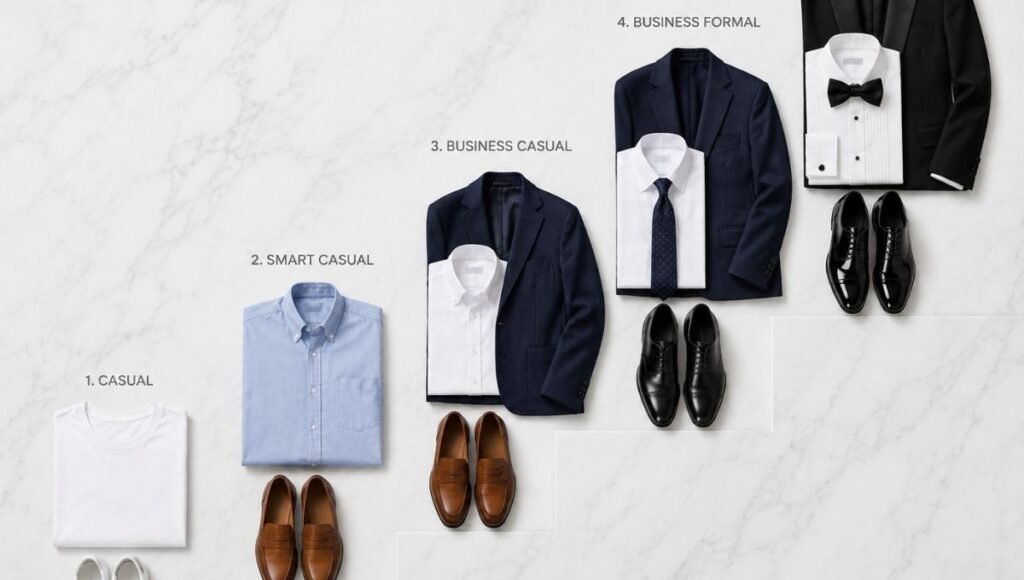
1. Casual
What it means: No real dress code. The occasion has no expectation of intentional dressing beyond being clean and covered.
The honest nuance: “Casual” doesn’t mean thoughtless. Casual at a friend’s dinner party and casual at a backyard barbecue share the label but not the standards. In social contexts, casual still means you made some decision about your appearance.
What to wear:
- Well-fitting dark jeans or clean chinos
- Plain crew-neck tee, polo, or relaxed shirt
- Clean sneakers or casual loafers
- Optional: light jacket, denim jacket, or overshirt for layering
What to avoid: Visibly worn or dirty clothing, athletic wear in social settings, anything that reads as you grabbed it without looking.
When you’ll encounter it: Weekend social plans, casual dinners with friends, low-key daytime events.
2. Smart Casual
What it means: The most misunderstood dress code in existence. Smart casual means you look like you considered the occasion without looking formal. Casual but intentional. Relaxed but polished.
Smart casual strikes a balance between formal and casual attire — it’s got the relaxed and comfortable feel of casual, but looks more put-together. It’s less professional than business casual but more sophisticated than running errands.
What to wear:
- Dark jeans or chinos (khaki, navy, or grey)
- Oxford shirt (tucked or untucked), polo, or neat crewneck
- Optional: unstructured blazer — adds instant polish without formality
- Leather loafers, clean leather sneakers, or chelsea boots
- No tie required
The one piece that changes everything: An unstructured navy blazer. Throw it over a white tee and dark jeans and you’re immediately in smart casual territory. Remove it and you’re in casual. The blazer is the lever.
What to avoid: Full suits (too formal), gym wear, overly casual graphics, worn trainers.
When you’ll encounter it: Casual restaurants, social dinners, rooftop events, relaxed evenings out, most modern office social events.
3. Business Casual
What it means: Professional enough for a workplace or professional context, relaxed enough that a full suit feels excessive. Business casual blends traditional businesswear with a more relaxed, modern approach — it skips the full suit-and-tie combo in favor of dress shirts, chinos or trousers, loafers, and optional blazers.
The important distinction: Business casual means different things in different industries. In finance or law, it means chinos and a blazer as the minimum. In tech, it might mean dark jeans and a neat shirt. Read your environment before defaulting to any universal interpretation.
What to wear (standard):
- Oxford shirt or polo, tucked in
- Chinos or dress trousers in navy, khaki, or grey
- Optional blazer or sport coat
- Leather loafers, oxford shoes, or chelsea boots
- No tie required (though having one accessible is useful)
What to wear (relaxed business casual / tech environments):
- Dark clean jeans without distressing
- Oxford shirt or neat crewneck
- Clean leather sneakers acceptable in most modern offices
- Blazer for client meetings or presentations
What to avoid: Jeans in traditional industries, t-shirts without a collar, visible logos, athletic shoes.
When you’ll encounter it: Most modern office environments, client lunches, professional conferences, job interviews at non-corporate companies.
4. Business Formal / Business Professional
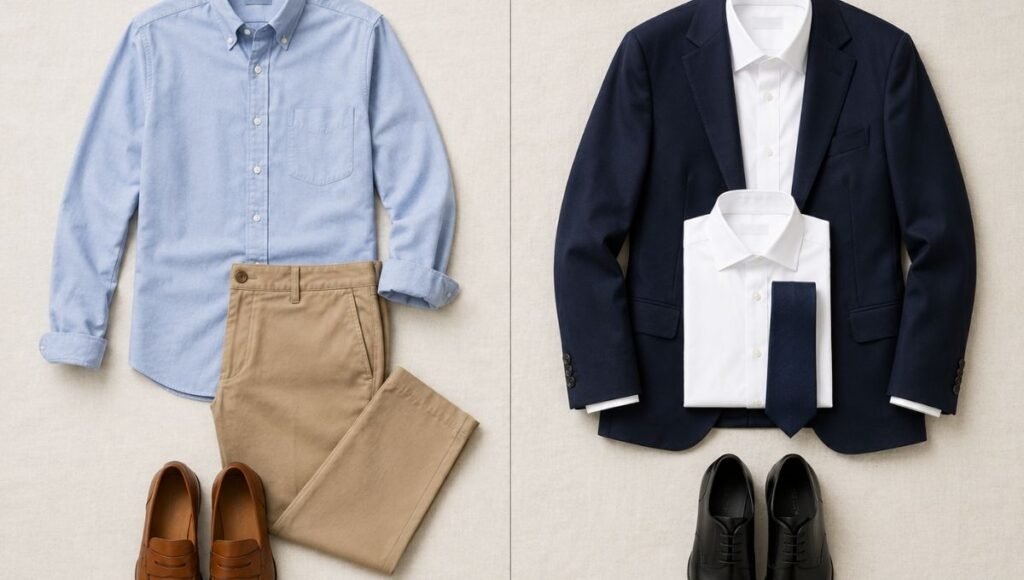
What it means: A suit is expected. This is the dress code of traditional corporate environments — finance, law, consulting, banking. Business formal typically involves suits in dark shades like black, navy, or charcoal, with ties mandatory and polished leather shoes and accessories expected.
What to wear:
- Dark suit (navy or charcoal — both more versatile than black for daytime formal)
- White or light blue dress shirt, pressed
- Conservative tie in a solid color or subtle pattern
- Black or dark brown leather Oxford shoes, polished
- Matching leather belt
The fit rule: In business formal contexts, fit is read as a proxy for professionalism. A well-fitting suit from an affordable brand consistently outperforms an expensive suit with poor fit. The shoulder seam, chest closure, and trouser break are the three points that matter most.
What to avoid: Casual shoes of any kind, unstructured jackets, missing tie in conservative environments, visible patterns in shirt or suit.
When you’ll encounter it: Traditional corporate offices, high-stakes client meetings, corporate interviews, formal professional events.
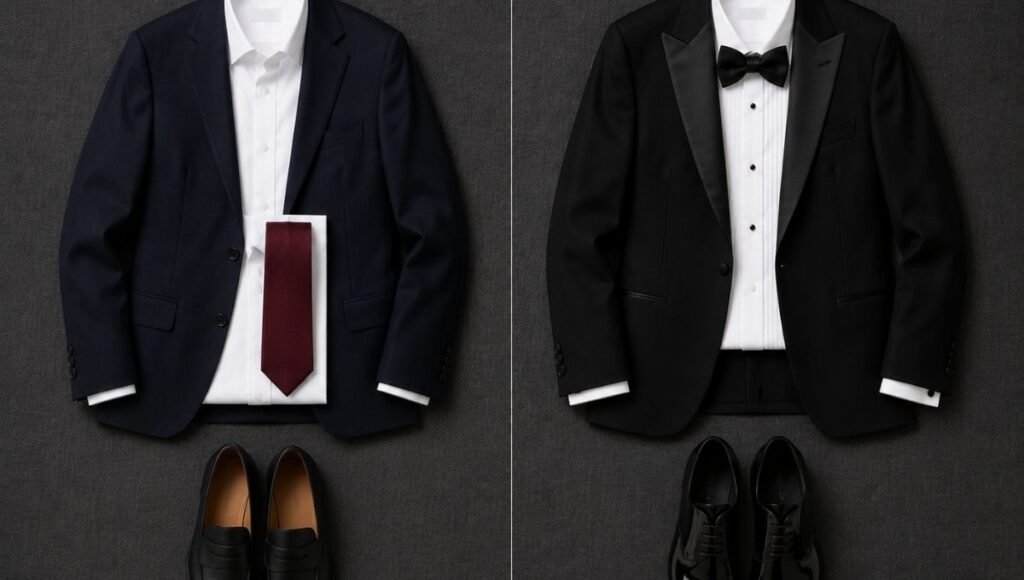
5. Semi-Formal / Cocktail Attire
What it means: An evening dress code that sits between business formal and black tie. More celebratory and stylish than an office suit, less strict than a tuxedo. Cocktail attire requires intentionality — you should look like you dressed specifically for the evening, not like you added a pocket square to your workday outfit.
What to wear:
- Dark suit in navy, charcoal, or midnight blue (more evening-appropriate than medium grey)
- White dress shirt
- Tie optional but often appropriate — silk tie in a solid or subtle pattern
- Black or dark brown leather Oxford shoes or loafers
- Pocket square adds finish without formality
The key distinction from business formal: Same suit, different energy. A cocktail event calls for something that reads as celebratory and considered rather than corporate. A midnight navy suit with a white shirt and no tie reads differently than a charcoal suit with a conservative tie — same formality level, different occasion register.
What to avoid: Regular business suits without any evening elevation, casual shoes, anything that reads as “I came from the office.”
When you’ll encounter it: Evening weddings, charity galas, holiday parties, upscale dinners, award events.
6. Black Tie Optional
What it means: A tuxedo is welcomed but not required. The couple or host wants a formal atmosphere but isn’t mandating evening wear. This is your permission to wear an exceptional suit instead of a tuxedo.
What to wear (suit option):
- Very dark navy or charcoal suit — the darkest you own
- White dress shirt
- Silk tie in a muted, elegant color
- Black Oxford shoes, polished
- Pocket square
What to wear (tuxedo option):
- Standard black tie (see below) — always appropriate at Black Tie Optional
The practical decision: If you own a tuxedo, wear it. If you don’t, treat this as an opportunity to wear your best, darkest suit with full attention to detail. The suit needs to read as intentionally formal — not just your regular business suit with a nicer tie.
What to avoid: Any medium or light grey suit, brown shoes, anything that reads as business rather than formal evening.
When you’ll encounter it: Formal weddings, charity galas, evening corporate events.
7. Black Tie
What it means: A tuxedo is expected. Black tie is the height of formal evening wear, usually reserved for occasions that demand a polished and sophisticated look — gala dinners, award ceremonies, and high-end weddings. The dress code is strict, leaving little room for personal interpretation.
What to wear:
- Black tuxedo jacket with satin lapels + matching trousers
- White dress shirt (pleated front or bib front)
- Black bow tie (pre-tied is acceptable)
- Black patent leather Oxford shoes or black cap-toe Oxfords
- Black cummerbund or waistcoat
If you don’t own a tuxedo: Rent one. Generation Tux, The Black Tux, and most local formal wear retailers offer quality rental options. Specify slim or modern fit — rental tuxedos often default to boxy cuts that date the look.
The one rule: Do not substitute a dark business suit at a genuine black tie event. The dress code exists for a reason and a suit, however good, reads as underdressed regardless of quality.
When you’ll encounter it: Formal galas, black tie weddings, award ceremonies, high-end evening events.
The Dress Code Hierarchy at a Glance
| Dress Code | Suit Required | Tie | Shoes |
|---|---|---|---|
| Casual | No | No | Clean sneakers or casual shoes |
| Smart Casual | No | No | Loafers, leather sneakers, or boots |
| Business Casual | Sometimes | No | Leather loafers or dress shoes |
| Business Formal | Yes | Yes | Polished leather Oxfords |
| Semi-Formal/Cocktail | Yes (dark) | Optional | Leather Oxfords |
| Black Tie Optional | Dark suit or tuxedo | Silk tie or bow tie | Black leather Oxfords |
| Black Tie | Tuxedo | Black bow tie | Black patent leather |
The Universal Rules That Apply Across Every Dress Code
Fit overrides everything. A well-fitting outfit in any dress code looks better than an ill-fitting one in the “correct” garments. The shoulder seam, chest fit, and trouser length are the three points that determine whether an outfit reads as put-together or assembled.
Shoes communicate formality first. Most people notice shoes before they register individual clothing choices. The right shoes at the right formality level is non-negotiable. Worn trainers under a blazer undermines the blazer entirely.
When in doubt, go one level up. Arriving slightly overdressed is almost always better than underdressed. You can remove a jacket, roll up sleeves, or loosen a tie to dial back formality. You cannot add formality you didn’t bring.
Fit matters more than brand. A well-fitting suit from a mid-range brand consistently outperforms an expensive suit with poor fit in every dress code context.
FAQ
What is the dress code for men at most events? Most events men encounter fall into three categories: casual or smart casual for social situations, business casual for most modern workplaces and professional events, and semi-formal or cocktail attire for evening celebrations. Black tie is encountered occasionally; white tie is rare enough that most men will never need it. When an invitation doesn’t specify a dress code, smart casual is the safest default.
What is the difference between smart casual and business casual for men? Smart casual is a social dress code — it applies to dinners, events, and casual occasions where you want to look intentional without being formal. Business casual is a professional dress code for workplace and client-facing contexts. The practical difference: smart casual allows jeans, untucked shirts, and casual shoes in most contexts; business casual typically requires trousers or chinos, a collared shirt, and leather shoes at minimum.
Do men need to wear a tie for business casual? No. Business casual explicitly removes the tie requirement from business formal. A collared shirt, chinos or dress trousers, and leather shoes without a tie is standard business casual in most environments. Having a tie accessible can be useful if the environment turns out more formal than expected — it can always be added, but cannot be removed if you didn’t bring one.
What should men wear when the dress code isn’t specified? Read the contextual signals: the venue, the time of day, and what you know about the host. A smart casual combination — dark jeans or chinos, an Oxford shirt, and leather loafers or boots — handles most ambiguous situations appropriately. If the event is in the evening or at a formal venue, add a blazer. When genuinely uncertain, contact the host and ask — it’s always the right move.
What is black tie optional for men? Black Tie Optional means a tuxedo is welcome but a very dark, formal suit is also acceptable. If you own a tuxedo, wear it. If not, treat it as an occasion for your darkest, best-fitting suit — navy or charcoal — with a white dress shirt, silk tie, and polished black leather shoes. Medium grey suits or business-register suits without evening elevation are too casual for this dress code.
Go Deeper: Modvello’s Occasion-Specific Guides
Each dress code above is explored in full detail across the following guides — specific outfit recommendations, industry variations, and what to do when you’re genuinely uncertain.
- Business Casual Dress Code for Men: What It Actually Means (Wardrobe Basics)
- What to Wear to a Wedding: The Men’s Complete Guide to Every Dress Code (Style by Occasion)
- What to Wear to a Job Interview: The Men’s Guide for Every Company Type (Style by Occasion)
- First Date Outfit for Men: What to Wear to Make the Right Impression (Style by Occasion)
- Men’s Work Outfits: Simple Business Casual Combinations for Every Day (Style by Occasion)
- What to Wear in Summer: The Men’s Guide to Looking Good When It’s Hot (Style by Occasion)
- Winter Outfits for Men: How to Layer Without Looking Bulky (Style by Occasion)
- Casual Outfit Ideas for Men: What to Wear When There’s No Dress Code (Outfit Ideas)
- Capsule Wardrobe for Men: 10 Basics That Cover Every Situation (Wardrobe Basics)
Last updated: June 2026 | Written by Daniel Ross